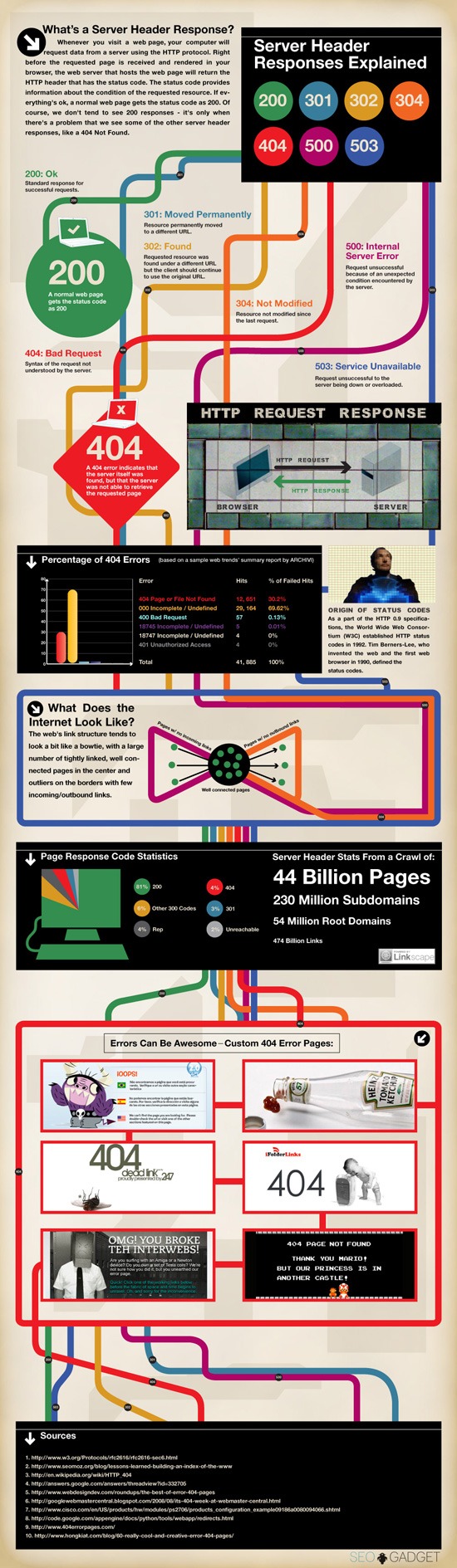
Server Headers 101 (Infographic)
For newbies in the business of crafting websites, the purpose and technicality behind server header responses can often be a little mind baffling to get to grips with. Although there are essentially so much to learn, only a few are common and essential to web professionals and the average user.
So what is a server header response, anyway? Well, let’s shed some light on them by delving deep into the most common server header responses.
Infographic by SEOgadget, a boutique SEO agency and blog located in London and maintained by a small team of passionate tech geeks and search wizards.
Related Content
- Firefox: By the Numbers
- Which Designer Job is the Best? (Infographic)
- What Your Web Design Says About You (Infographic)
- Related categories: Infographics and Web Development


27 Comments
Peter Joseph
April 18th, 2011
I’ve never really bothered with this stuff and just gone along with it, but this infographic made it much more clear, thanks :)
Prasad
April 18th, 2011
Wow! That’s a sweet explanation :)
Alessandro Pucci
April 18th, 2011
The Super Mario 404 error page is awesome :)
Jatin
April 18th, 2011
Nice way to make someone understand server headers.
Great Article.
MartÃn
April 18th, 2011
Great infography SR!. I always learn something new reading this blog and today i decided to post a comment ;) Best regards from Argentina.
Sam Canada
April 18th, 2011
Clear and easy to understand for anyone that is looking to demystified the most commons HTTP headers. Web pro’ should all know that by heart tho’ ;-)
Nils
April 18th, 2011
Bad Request is HTTP error 400, not 404
bill
April 18th, 2011
I prefer the 404 page at http://www.notonebit.com/404
Michael Tuck
April 18th, 2011
Nice job. Bookmarked and referenced. Will be fun to print out and post on the wall at some future time. This is good for a classroom as well as an office or cubby.
Newbie
April 19th, 2011
Thank you..
505 human error?
Tri
April 19th, 2011
This infographic is really good. Design is amazing. Up until now, I have only accounted for 404 page errors, but I will have to look into 301 and redirects too
Korwin
April 19th, 2011
Great explanation ;)
Dustin Montgomery
April 19th, 2011
Like Nils said, the graphic displays 404 instead of 400 for the Bad Request.
Entertaining though!
Richard
April 20th, 2011
Thanks all for spotting the error – a 404 is a page not found, not a bad request. My bad! I think you can look at something for too long and start missing things like this :-)
Thanks for all the nice comments, glad you found this useful.
Mark Nottingham
April 25th, 2011
Hi,
HTTP/0.9 didn’t have status codes nor headers; the response was simply the HTML. Status codes and response headers came with HTTP/1.0, defined in RFC1945.
Also, a better name for this would be “HTTP Response Status Codes” or something similar, since it doesn’t go into detail on the headers themselves.
Cheers,
kitz dunphy
April 27th, 2011
I really like that straightforward way of explaining header responses. Would make a useful learning resource. And looks like a cool version of the London tube map :)
Daniel Fisher
April 27th, 2011
Nice – but Bad Request is 400 NOT 404 :-)
Richard
April 27th, 2011
Thanks Mark – very useful feedback and apologies for the http version error!
Richard
April 28th, 2011
You might also see “307 Temporary Redirect”. It’s not as common as 301 or 302, but it does come up occasionally.
http://en.wikipedia.org/wiki/HTTP_status_code#3xx_Redirection
Ivan Vanderbyl
April 29th, 2011
It’s missing HTTP 418 “I am a teapot”
Sergio
April 29th, 2011
Loved mario one
Alexey Romanyuk
May 5th, 2011
It’s a very effective presentation of information. Good work!
Andy
June 1st, 2011
Came here from a link from the SEOmoz blog, the author created an a web page status code infographic, and found out that you created something similar. Thanks for the article!
Neil M
June 2nd, 2011
Linked here from an SEOmoz post by Dr.Pete. His was helpful for a SEO newbie like me but this one makes me feel like an expert on status codes. My team and I are also in the process of making our first infographic on identity theft… Hope it turns out something like this one.
Thanks for the info.
searchengineman
June 2nd, 2011
I too came from SEOmoz blog article
http://www.seomoz.org/blog/an-seos-guide-to-http-status-codes
..nice Info Graphic keep up the good work.
Searchengineman
Suren Sarukhanyan
June 7th, 2011
hey, nice graphics and nice epxplanation, especially when you come from this article on SEOMOZ http://www.seomoz.org/blog/an-seos-guide-to-http-status-codes :)
Alejandro
June 22nd, 2011
Thanks for the info! Now I have a question:
What does “Rep” mean, in the context of 4% of 44 Billion pages were “Rep”?
I would appreciate a link to a definition if possible.
Leave a Comment