The History of the Internet in a Nutshell
If you’re reading this article, it’s likely that you spend a fair amount of time online. However, considering how much of an influence the Internet has in our daily lives, how many of us actually know the story of how it got its start?
Here’s a brief history of the Internet, including important dates, people, projects, sites, and other information that should give you at least a partial picture of what this thing we call the Internet really is, and where it came from.

While the complete history of the Internet could easily fill a few books, this article should familiarize you with key milestones and events related to the growth and evolution of the Internet between 1969 to 2009.
1969: Arpanet
Arpanet was the first real network to run on packet switching technology (new at the time). On the October 29, 1969, computers at Stanford and UCLA connected for the first time. In effect, they were the first hosts on what would one day become the Internet.
The first message sent across the network was supposed to be "Login", but reportedly, the link between the two colleges crashed on the letter "g".
1969: Unix

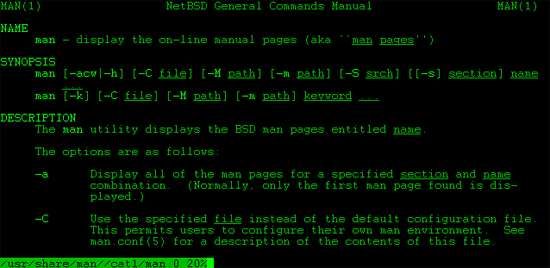
Another major milestone during the 60’s was the inception of Unix: the operating system whose design heavily influenced that of Linux and FreeBSD (the operating systems most popular in today’s web servers/web hosting services).
1970: Arpanet network
An Arpanet network was established between Harvard, MIT, and BBN (the company that created the "interface message processor" computers used to connect to the network) in 1970.
1971: Email

Email was first developed in 1971 by Ray Tomlinson, who also made the decision to use the "@" symbol to separate the user name from the computer name (which later on became the domain name).
1971: Project Gutenberg and eBooks
One of the most impressive developments of 1971 was the start of Project Gutenberg. Project Gutenberg, for those unfamiliar with the site, is a global effort to make books and documents in the public domain available electronically–for free–in a variety of eBook and electronic formats.
It began when Michael Hart gained access to a large block of computing time and came to the realization that the future of computers wasn’t in computing itself, but in the storage, retrieval and searching of information that, at the time, was only contained in libraries. He manually typed (no OCR at the time) the "Declaration of Independence" and launched Project Gutenberg to make information contained in books widely available in electronic form. In effect, this was the birth of the eBook.
1972: CYCLADES
France began its own Arpanet-like project in 1972, called CYCLADES. While Cyclades was eventually shut down, it did pioneer a key idea: the host computer should be responsible for data transmission rather than the network itself.
1973: The first trans-Atlantic connection and the popularity of emailing
Arpanet made its first trans-Atlantic connection in 1973, with the University College of London. During the same year, email accounted for 75% of all Arpanet network activity.
1974: The beginning of TCP/IP

1974 was a breakthrough year. A proposal was published to link Arpa-like networks together into a so-called "inter-network", which would have no central control and would work around a transmission control protocol (which eventually became TCP/IP).
1975: The email client
With the popularity of emailing, the first modern email program was developed by John Vittal, a programmer at the University of Southern California in 1975. The biggest technological advance this program (called MSG) made was the addition of "Reply" and "Forward" functionality.
1977: The PC modem
1977 was a big year for the development of the Internet as we know it today. It’s the year the first PC modem, developed by Dennis Hayes and Dale Heatherington, was introduced and initially sold to computer hobbyists.
1978: The Bulletin Board System (BBS)
The first bulletin board system (BBS) was developed during a blizzard in Chicago in 1978.
1978: Spam is born
1978 is also the year that brought the first unsolicited commercial email message (later known as spam), sent out to 600 California Arpanet users by Gary Thuerk.
1979: MUD – The earliest form of multiplayer games
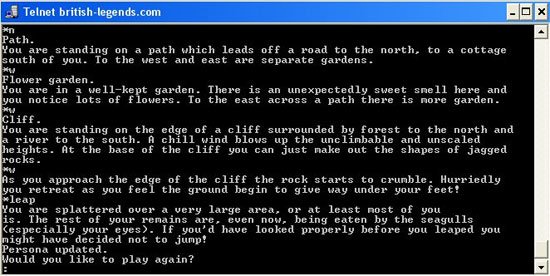
The precursor to World of Warcraft and Second Life was developed in 1979, and was called MUD (short for MultiUser Dungeon). MUDs were entirely text-based virtual worlds, combining elements of role-playing games, interactive, fiction, and online chat.
1979: Usenet
1979 also ushered into the scene: Usenet, created by two graduate students. Usenet was an internet-based discussion system, allowing people from around the globe to converse about the same topics by posting public messages categorized by newsgroups.
1980: ENQUIRE software
The European Organization for Nuclear Research (better known as CERN) launched ENQUIRE (written by Tim Berners-Lee), a hypertext program that allowed scientists at the particle physics lab to keep track of people, software, and projects using hypertext (hyperlinks).
1982: The first emoticon
![]()
While many people credit Kevin MacKenzie with the invention of the emoticon in 1979, it was Scott Fahlman in 1982 who proposed using :-) after a joke, rather than the original -) proposed by MacKenzie. The modern emoticon was born.
1983: Arpanet computers switch over to TCP/IP
January 1, 1983 was the deadline for Arpanet computers to switch over to the TCP/IP protocols developed by Vinton Cerf. A few hundred computers were affected by the switch. The name server was also developed in ‘83.
1984: Domain Name System (DNS)
The domain name system was created in 1984 along with the first Domain Name Servers (DNS). The domain name system was important in that it made addresses on the Internet more human-friendly compared to its numerical IP address counterparts. DNS servers allowed Internet users to type in an easy-to-remember domain name and then converted it to the IP address automatically.
1985: Virtual communities
1985 brought the development of The WELL (short for Whole Earth ‘Lectronic Link), one of the oldest virtual communities still in operation. It was developed by Stewart Brand and Larry Brilliant in February of ‘85. It started out as a community of the readers and writers of the Whole Earth Review and was an open but "remarkably literate and uninhibited intellectual gathering". Wired Magazine once called The Well "The most influential online community in the world."
1986: Protocol wars
The so-called Protocol wars began in 1986. European countries at that time were pursuing the Open Systems Interconnection (OSI), while the United States was using the Internet/Arpanet protocol, which eventually won out.
1987: The Internet grows
By 1987, there were nearly 30,000 hosts on the Internet. The original Arpanet protocol had been limited to 1,000 hosts, but the adoption of the TCP/IP standard made larger numbers of hosts possible.
1988: IRC – Internet Relay Chat
Also in 1988, Internet Relay Chat (IRC) was first deployed, paving the way for real-time chat and the instant messaging programs we use today.
1988: First major malicious internet-based attack
One of the first major Internet worms was released in 1988. Referred to as "The Morris Worm", it was written by Robert Tappan Morris and caused major interruptions across large parts of the Internet.
1989: AOL is launched
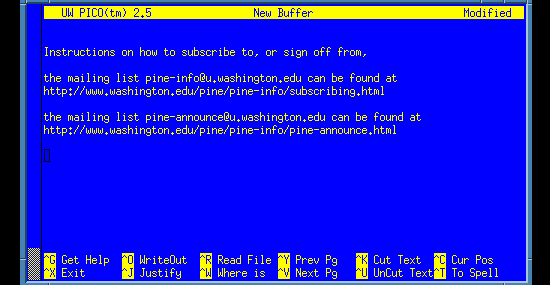
When Apple pulled out of the AppleLink program in 1989, the project was renamed and America Online was born. AOL, still in existence today, later on made the Internet popular amongst the average internet users.
1989: The proposal for the World Wide Web
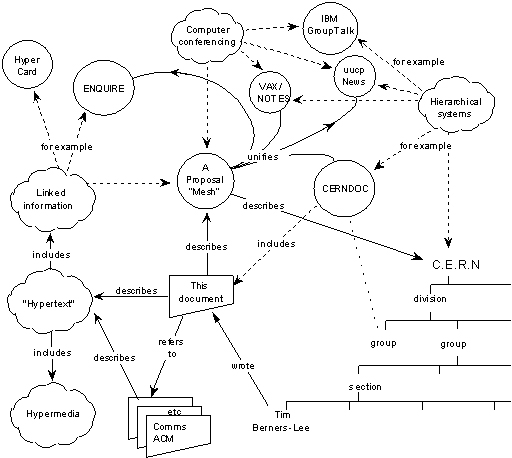
1989 also brought about the proposal for the World Wide Web, written by Tim Berners-Lee. It was originally published in the March issue of MacWorld, and then redistributed in May 1990. It was written to persuade CERN that a global hypertext system was in CERN’s best interest. It was originally called "Mesh"; the term "World Wide Web" was coined while Berners-Lee was writing the code in 1990.
1990: First commercial dial-up ISP
1990 also brought about the first commercial dial-up Internet provider, The World. The same year, Arpanet ceased to exist.
1990: World Wide Web protocols finished
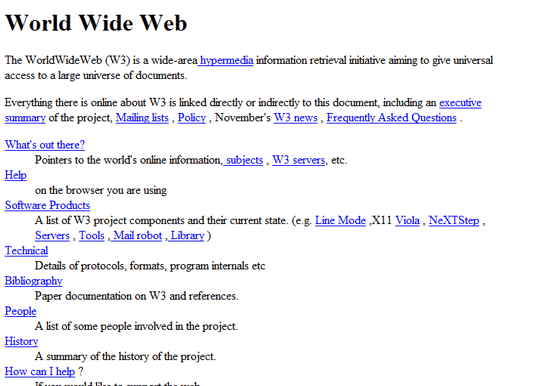
The code for the World Wide Web was written by Tim Berners-Lee, based on his proposal from the year before, along with the standards for HTML, HTTP, and URLs.
1991: First web page created
1991 brought some major innovations to the world of the Internet. The first web page was created and, much like the first email explained what email was, its purpose was to explain what the World Wide Web was.
1991: First content-based search protocol
Also in the same year, the first search protocol that examined file contents instead of just file names was launched, called Gopher.
1991: MP3 becomes a standard
Also, the MP3 file format was accepted as a standard in 1991. MP3 files, being highly compressed, later become a popular file format to share songs and entire albums via the internet.
1991: The first webcam

One of the more interesting developments of this era, though, was the first webcam. It was deployed at a Cambridge University computer lab, and its sole purpose was to monitor a particular coffee maker so that lab users could avoid wasted trips to an empty coffee pot.
1993: Mosaic – first graphical web browser for the general public
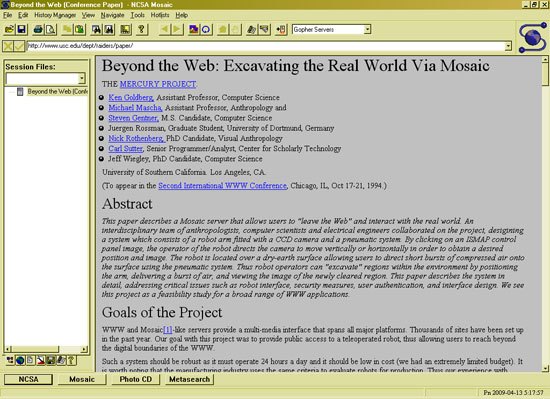
The first widely downloaded Internet browser, Mosaic, was released in 1993. While Mosaic wasn’t the first web browser, it is considered the first browser to make the Internet easily accessible to non-techies.
1993: Governments join in on the fun
In 1993, both the White House and the United Nations came online, marking the beginning of the .gov and .org domain names.
1994: Netscape Navigator
Mosaic’s first big competitor, Netscape Navigator, was released the year following (1994).
1995: Commercialization of the internet
1995 is often considered the first year the web became commercialized. While there were commercial enterprises online prior to ‘95, there were a few key developments that happened that year. First, SSL (Secure Sockets Layer) encryption was developed by Netscape, making it safer to conduct financial transactions (like credit card payments) online.
In addition, two major online businesses got their start the same year. The first sale on "Echo Bay" was made that year. Echo Bay later became eBay. Amazon.com also started in 1995, though it didn’t turn a profit for six years, until 2001.
1995: Geocities, the Vatican goes online, and JavaScript
Other major developments that year included the launch of Geocities (which officially closed down on October 26, 2009).
The Vatican also went online for the first time.
Java and JavaScript (originally called LiveScript by its creator, Brendan Eich, and deployed as part of the Netscape Navigator browser – see comments for explanation) was first introduced to the public in 1995. ActiveX was launched by Microsoft the following year.
1996: First web-based (webmail) service
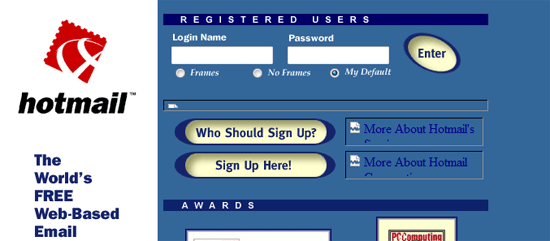
In 1996, HoTMaiL (the capitalized letters are an homage to HTML), the first webmail service, was launched.
1997: The term "weblog" is coined
While the first blogs had been around for a few years in one form or another, 1997 was the first year the term "weblog" was used.
1998: First new story to be broken online instead of traditional media
In 1998, the first major news story to be broken online was the Bill Clinton/Monica Lewinsky scandal (also referred to as "Monicagate" among other nicknames), which was posted on The Drudge Report after Newsweek killed the story.
1998: Google!
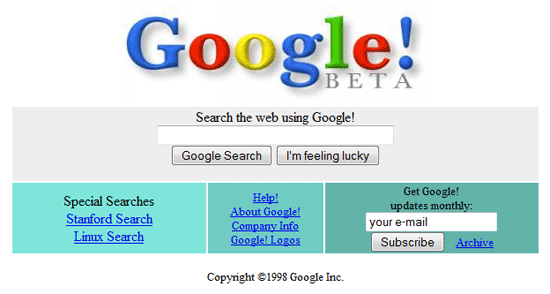
Google went live in 1998, revolutionizing the way in which people find information online.
1998: Internet-based file-sharing gets its roots
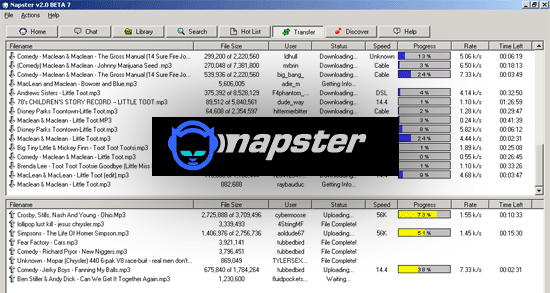
In 1998 as well, Napster launched, opening up the gates to mainstream file-sharing of audio files over the internet.
1999: SETI@home project
1999 is the year when one of the more interesting projects ever brought online: the SETI@home project, launched. The project has created the equivalent of a giant supercomputer by harnessing the computing power of more than 3 million computers worldwide, using their processors whenever the screensaver comes on, indicating that the computer is idle. The program analyzes radio telescope data to look for signs of extraterrestrial intelligence.
2000: The bubble bursts
2000 was the year of the dotcom collapse, resulting in huge losses for legions of investors. Hundreds of companies closed, some of which had never turned a profit for their investors. The NASDAQ, which listed a large number of tech companies affected by the bubble, peaked at over 5,000, then lost 10% of its value in a single day, and finally hit bottom in October of 2002.
2001: Wikipedia is launched
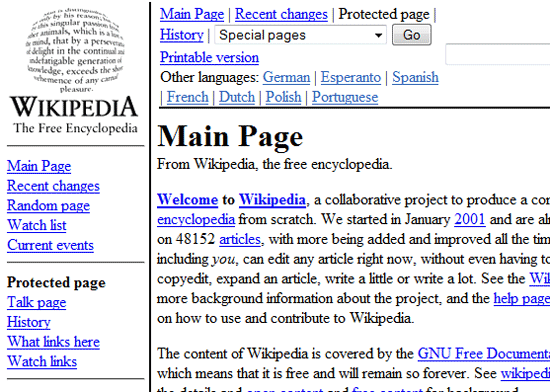
With the dotcom collapse still going strong, Wikipedia launched in 2001, one of the websites that paved the way for collective web content generation/social media.
2003: VoIP goes mainstream
In 2003: Skype is released to the public, giving a user-friendly interface to Voice over IP calling.
2003: MySpace becomes the most popular social network
Also in 2003, MySpace opens up its doors. It later grew to be the most popular social network at one time (thought it has since been overtaken by Facebook).
2003: CAN-SPAM Act puts a lid on unsolicited emails
Another major advance in 2003 was the signing of the Controlling the Assault of Non-Solicited Pornography and Marketing Act of 2003, better known as the CAN-SPAM Act.
2004: Web 2.0
Though coined in 1999 by Darcy DiNucci, the term "Web 2.0", referring to websites and Rich Internet Applications (RIA) that are highly interactive and user-driven became popular around 2004. During the first Web 2.0 conference, John Batelle and Tim O’Reilly described the concept of "the Web as a Platform": software applications built to take advantage of internet connectivity, moving away from the desktop (which has downsides such as operating system dependency and lack of interoperability).
2004: Social Media and Digg
The term "social media", believed to be first used by Chris Sharpley, was coined in the same year that "Web 2.0" became a mainstream concept. Social media–sites and web applications that allow its users to create and share content and to connect with one another–started around this period.

Digg, a social news site, launched on November of 2004, paving the way for sites such as Reddit, Mixx, and Yahoo! Buzz. Digg revolutionized traditional means of generating and finding web content, democratically promoting news and web links that are reviewed and voted on by a community.
2004: "The" Facebook open to college students

Facebook launched in 2004, though at the time it was only open to college students and was called "The Facebook"; later on, "The" was dropped from the name, though the URL http://www.thefacebook.com still works.
2005: YouTube – streaming video for the masses
YouTube launched in 2005, bringing free online video hosting and sharing to the masses.
2006: Twitter gets twittering
Twitter launched in 2006. It was originally going to be called twittr (inspired by Flickr); the first Twitter message was "just setting up my twttr".
2007: Major move to place TV shows online
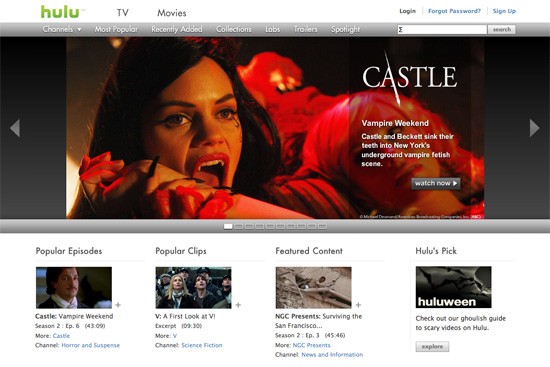
Hulu was first launched in 2007, a joint venture between ABC, NBC, and Fox to make popular TV shows available to watch online.
2007: The iPhone and the Mobile Web

The biggest innovation of 2007 was almost certainly the iPhone, which was almost wholly responsible for renewed interest in mobile web applications and design.
2008: "Internet Election"
The first "Internet election" took place in 2008 with the U.S. Presidential election. It was the first year that national candidates took full advantage of all the Internet had to offer. Hillary Clinton jumped on board early with YouTube campaign videos. Virtually every candidate had a Facebook page or a Twitter feed, or both.
Ron Paul set a new fundraising record by raising $4.3 million in a single day through online donations, and then beat his own record only weeks later by raising $4.4 million in a single day.
The 2008 elections placed the Internet squarely at the forefront of politics and campaigning, a trend that is unlikely to change any time in the near future.
2009: ICANN policy changes
2009 brought about one of the biggest changes to come to the Internet in a long time when the U.S. relaxed its control over ICANN, the official naming body of the Internet (they’re the organization in charge of registering domain names).
The Future?
Where is the future of the Internet headed? Share your opinions in the comments section.
Sources and Further Reading
- A People’s History of the Internet: from Arpanet in 1969 to Today: A timeline of the Internet from guardian.co.uk.
- History of the Internet: An early timeline of the Internet, from precursors in the 1800s up through 1997.
- A Brief History of the Web: A series of videos from Microsoft to celebrate the launch of Internet Explorer 8.
- The History of the Internet – Tim Berners-Lee: A brief history of major developments associated with the Internet from About.com.
- Hobbes’ Internet Timeline – the definitive ARPAnet & Internet History: A very thorough timeline of the Internet, starting in 1957 and going up through 2004, with tons of statistics and source material included.
- Internet Timeline: A basic timeline of Internet history from FactMonster.com.
Related Content
- The History of Web Browsers
- Popular Search Engines in the 90’s: Then and Now
- 10 Revealing Infographics about the Web
- Related categories: Web Development and Infographics
About the Author


199 Comments
Matt
November 15th, 2009
Wow. That’s an impressive timeline. It’s neat to see where this thing started and what it’s come to. What does the future hold? :p
Oystein
November 15th, 2009
“Arpanet made its first trans-Atlantic connection in 1973, with the University College of London.”
This cant be right..
First Norway got connected tre 20 min befour london..
Arren
November 15th, 2009
Only now I know where The Internet comes from. Great resource compilation.
Oystein
November 15th, 2009
To be more presice NORSTAR (Norwegian Seismic Array) At Kjeller in Norway. UCL was then connected through Kjeller.
Joe Scanlon
November 15th, 2009
Cool post – So we have Scott Fahlman to blame for all the :-) then!
Design Informer
November 15th, 2009
Awesome article! I’m really liking these recent articles from six revisions. Very well researched!
Al Gore
November 15th, 2009
Wait a minute – I thought I created the internet!
Al
Martin Leblanc
November 15th, 2009
Great blog post. Thanks for doing such fine research :-)
Dawn Baird
November 15th, 2009
Fascinating read, even if I can’t understand all the terminology!
Mediumjones
November 15th, 2009
Wow, seriously quality article. Bravo!
Austin
November 15th, 2009
Awesome post! I bet that it’s surprising to a lot of people that HTTP wasn’t the beginnings of the Internet. When you hear the term ‘Internet’, most people think of the WWW and browsing HyperText Documents.
Sampad Swain
November 15th, 2009
Great resource. Bookmarked the article for my future use.
Thanks
@Sampad
Baylink
November 15th, 2009
Well, I was around for most of it, and that’s about the nicest precis I’ve seen so far. I don’t get as many reads as @Alyssa_Milano, but we’ve both tweeted it. :-)
Dylan Parry
November 15th, 2009
Nice article. Found quite a few things that I didn’t know about the Internet from reading it. One small thing though – JavaScript wasn’t created by Sun Microsystems… a marketing deal between Sun and Netscape is the reason why it’s called JavaScript, but it was created and released initially by Netscape.
In exchange for Netscape being allowed to package and release Sun’s Java runtime as part of Netscape Navigator, Netscape agreed to call their new scripting language JavaScript. It was originally called Mocha, then renamed LiveScript, then finally JavaScript.
So Sun was involved somewhat, in fact they owned (still own?) the trademark on the name JavaScript, but they didn’t really have anything to do with its creation.
Mats Ahlqvist
November 15th, 2009
Where is the future of the Internet headed ?
First , is there a difference between the Internet and the Web ? If we look back to the origin we see that cooperation between universitys was the intention and driving force . That is the spirit of Internet . The spirit of the Web is more common commercialization and interests .
It is natural that progress will be made both on the Internet and on the Web . Bigger , faster and more complex tech for advanced software . It is the HW tech that sets the boundries for what can be done . But already there is very much that can be done with time and money .
Also travelling to Mars will make an impact on Internet/WWWeb . Communication will be further advanced and more sophisticated .
The commercial forces will want to enroll more and more people into WWWeconomy and that might be a good thing . Whats the difference between working on the WWWeb and the labormarket – should there be a difference ? No need to worry if the difference is a good difference . But yes , can government allow WWW to control the making of daily bread ?
So much to know . So much to remember . So many fascilities and tools and machines and programs and levels and dimensions and matrix´s and codes and versions and upgrades it isn´t at all strange people wonder in awe .
But I believe in the systemstructure to keep the train on the track and if I am wrong we can make it right .
Brent
November 15th, 2009
Nice article!
Although, there were search engines before Google. Yahoo! (’94) and AltaVista (’95) were probably the two largest.
kcidau
November 15th, 2009
Great article! One slight error I’ve noticed though: JavaScript wasn’t developed by Sun, but by Netscape.
http://en.wikipedia.org/wiki/JavaScript#History_and_naming
Louis-Pierre Dahito
November 15th, 2009
Amazing article! Thx for sharing. I’ve been looking for something like this for quite a while.
Tim
November 15th, 2009
Correction: JavaScript was actually created by Netscape and Mozilla in 1995 and had no relation to Java by Sun Microsystems except that they wanted to make it look like Java so it would be easy to work with.
vldr
November 15th, 2009
Gopher was not a search engine
Zach Echlin
November 15th, 2009
A small typo. Sun didn’t develop JavaScript–Netscape did.
KntL
November 15th, 2009
cameron, what did you do? this post is f**kin’ amazing… thx for this hard work…
Brian Dear
November 15th, 2009
You’re flat wrong about “1979: MUD – The earliest form of multiplayer games”. Incredibly, extremely, embarrassingly wrong. Do your homework.
Khoa
November 15th, 2009
Thanks for the great article.
Apparently Google is the biggest breakthrough because it’s the only one what has an exclamation mark “!” on its section heading. It feels like the author is shouting out “Google! Here you come!” :-P
Andy Berkvam
November 15th, 2009
Gopher is not a search engine any more than the world wide web is a search engine. Veronica and Jughead were search engines for the Gopher protocol however they both only indexed the names of menu items, not the actual file contents.
Nathan Nahm
November 15th, 2009
Thank you for writing an excellent summary of the complicated history of the Internet and for publishing it in a publicly accessible site. Like Tim Bernes-Lee, who wrote and dedicated the protocol for WWW to the public domain, you are one of the heroes who make the technological innovations work for everyone, rather than enrich a few business proprietors, who somehow acquire the legal rights to the innovations made other creative people and then use the technology exclusively for their personal profits.
Andre
November 15th, 2009
I guess it’s no surprise to anyone now that we are moving into a world where just about everything electronic will be capable of connecting to the internet.
A beautiful world!
Carmen
November 15th, 2009
Huh, wasn’t it Al Gore who invented the Internet? :D
Mark
November 15th, 2009
Cameron. Great post! Very interesting. I didn’t know Napoleon Dynamite invented the modem.
Geekoid
November 15th, 2009
An excellent and well written article, Cameron. Thoroughly enjoyed it, and it brought back some memories from the early days! Thank you for sharing your research and insight.
Raelifin
November 15th, 2009
Future of the web? If Google is to believed, cloud computing will take over as the primary means of computing, shifting us back to the mainframe/terminal mode of using computers. This means that internet connected devices don’t need much besides huge pipes, so netbooks and smartphones will continue to kill off the tower-based PC.
Cloud computing also creates a huge demand for standards and interfaces that will allow web-apps to easily communicate and share info. This should lead to the end of the typically anonymous web, as user profiles will sync, creating persistent identity.
In short, take current trends and project outward. As more of the world comes online expect to see exponential growth. That’s my take on things.
Mark Alves
November 15th, 2009
Who new that Napoleon Dynamite invented the modem?! Seriously, thanks for putting together an interesting post with great graphics.
AndrewNoNumbers
November 15th, 2009
That’s quite a huge nutshell. I don’t have time to read it at the moment, but I really look forward to it.
conancat
November 15th, 2009
i love this article! thank you for putting the history of internet in such accessible manner, it is a pretty interesting read, knowing when our most popular websites started :D
Jeremy
November 15th, 2009
JavaScript was not developed by Sun. It was developed by Netscape.
Kevin
November 15th, 2009
I noticed you had SETI@home starting in 1999. Pretty sure I was using it much earlier than that. I worked for AOL shortly after its beginning, and I remember our IT dept banning it because of the network resources it was consuming.
Good article though :) Another thing is you left out CServ & DowJones network, which were pretty big around the days of BBS’s.
jaychivo
November 15th, 2009
wahoo, great info of internet,very impressive.
Sandhya
November 15th, 2009
awsome article…realy enjoyed readin it :)
The Classic Carol
November 15th, 2009
Awesome compilation of data. What a great history lesson. I wonder how many people online now were born after the internet was invented. Woot, 1969!
corwin
November 15th, 2009
This was a great comprehensive timeline. I remember most of it, but still learned a lot. Thanks!
Pedants R. Us
November 15th, 2009
Just one minor correction: Javascript was developed by Netscape, not Sun. Java and Javascript aren’t related apart from the similarity of their names.
gxs
November 16th, 2009
I like how this whole article conveniently leaved Windows out. It’s so blatant that it ruins an otherwise good read.
John Heatherington
November 16th, 2009
FYI, you spelled my cousin’s name incorrectly. Under year 1977, it’s Dale “Heatherington”. Here’s his website for reference. No worries. =)
http://www.wa4dsy.net/robot/home/about
Ejaz
November 16th, 2009
Great, concise and very informative article. You must have worked very hard to prepare it. Thanks
huza
November 16th, 2009
now thats a good read! Great job! :D
Naresh
November 16th, 2009
Superb article. Thanks a lot!
hectore
November 16th, 2009
No Yahoo? you’ve got to be kidding!!! back in 95 the place to go to find stuff on the web was the obscure page at Stanford that would later become yahoo. This definately has to be on the list!
Frank
November 16th, 2009
Great story. The internet is so young and already this many milestones. Maybe a nice addon http://www.slideshare.net/Yes2web/a-short-history-of-internet in this presentation you can also see the immense growth of the internet: and the rising of the mobile web.
Troy
November 16th, 2009
An ass-suckingly awful history that doesn’t mention Leonard Kleinrock or Vinton Cerf. Back to the drawing board.
Narno
November 16th, 2009
Very interesting article, easy to read and with a lot of references. Thx Cameron! :-)
Wilhelm Fitzpatrick
November 16th, 2009
Just for the record:
* Java was launched by Sun Microsystems.
* JavaScript was originally called LiveScript and was created at Netscape, and included in a version of the Netscape Browser. Shortly after its original introduction, some misguided marketeer renamed LiveScript to JavaScript even though the language had no relation to, and is in fact quite different from, Java.
Randy
November 16th, 2009
Javascript came from Netscape and Internet explorer used Mosaic sourcecode.
Callum Chapman
November 16th, 2009
Great post Cameron! From the year of my birth to the current day, we’ve managed to transform the first purely text-based website into works of art viewed by billions of people every day that we can view on huge glossy monitors and tiny iPhone screens in our pockets – because of this I’m really not too sure what could happen next! I think maybe Flickr should have made it into your timeline, though ;)
Webecta
November 16th, 2009
Although the Internet has been around for 40+ years, most people have only really used it as it is today for 10-20 years. Thanks for the great look at how the Internet was created!
PaulS
November 16th, 2009
Great article, but what about FTP! FTP existed before TCP/IP:
The first FTP standard was RFC 114, published in April 1971, before TCP and IP even existed.
(from http://www.tcpipguide.com/free/t_FTPOverviewHistoryandStandards.htm)
It’s one of the oldest protocols around(created the same year as email), and is still very widely used. A must for any proper history of the internet, if you as me ;-)
You might also considering adding the RFC process and then the appropriate RFC’s to the standards.
Jacob Gube
November 16th, 2009
Thank you all for your time in commenting and making this article better and more accurate.
@Dylan Parry and to the other people that noted the JavaScript error (@Tim, @Zach Echlin, @Jeremy, @Pedants R. Us, Randy, @Wilhelm Fitzpatrick with a nice bullet-point explanation): I apologize for that, I should have caught that easily being a JavaScript nut myself, but somehow I missed it. I’ve corrected it and linked to @Dylan Parry’s comment.
@Mats Ahlqvist: I can’t tell if you’re being funny or serious.
@Brent: I see what you’re saying, and yes, there should’ve been some sort of mention regarding search engines like Altavista, Yahoo!, Hotbot, heck even MSN search, which did help us find stuff on the internet.
@Raelifin: Alright, so I’m not the only geek thinking about establishing standards because of this shift to the cloud. “Interoperability” within web apps, which sort of realizes itself now as public API’s, is the word I’m looking for. Now we just need a singular/standardized API specifications. Your comment just inspired me with like 5 article topics right there. :)
@Mark Alves: I couldn’t help but laugh after having to scroll up and see what you mean.
markwill
November 16th, 2009
hi all,
ok where are the world famous first homecomputers like: atari, c64 or sinclair? or the first OS eg windows groups 3.11. ?greets markwill
aguy
November 16th, 2009
Huh. I don’t mean to make a political condemnation here but why would you put up a picture of Ron Paul when Obama was clearly the one who really made it clear that the internet is an effective campaign tool? Sure, Ron Paul made a massive amount of money on one day, but Obama made literally hundreds of millions throughout the campaign and also recruited thousands of contributors in many different states. Sure, the internet had Ron Paul fever for quite some time but Obama fever was FAR mode ubiquitous and widespread and even spread to other countries, far more so than Ron Paul did.
KL
November 16th, 2009
Why does the AOL picture have pico/pine running under Motif instead of the AOL or Q-Link client?
Mark
November 16th, 2009
No mention of the fact that ARPANET came from a military cold-war era project (DARPANET) to develop a communications network that could survive a nuclear war. This is why the ‘net’ approach was chosen. In the first diagram on the page the Pentagon is even one of the nodes…
Jonathan
November 16th, 2009
You left out BITnet. I had thought that the portals with CERN and Arpa and others were a big deal in pulling the www together. No?
Didn’t know about MUD. Played single player, text-based Adventure (never got through the crack in the rock). We played Al Alamein, on a board, with dice, and talked about figuring out a way to have each of us in a tank, on the computer…
TRR - Justin
November 16th, 2009
Thank you. The World needs this article.
Internet for all, Internet forever.
go@seo
November 16th, 2009
i miss a MIRC pic… , but well, super impressive post :)
jansegers
November 16th, 2009
There seems to be some discussion about the very first twitter message… I’m quite sure I’ve already heart an other version of it…
Shaymein
November 16th, 2009
Great interview from NPR Talk of the Nation about the Arpanet:
http://www.npr.org/templates/story/story.php?storyId=114319703
david
November 16th, 2009
Do you mean Al Gore didn’t invent it? how preposterous!
Tommy
November 16th, 2009
Very cool post :) I’m surprised to see how early it all began.
Louis
November 16th, 2009
Napoleon Dynamite invented the modem… That really made me laugh.
Great article.
Reinier Post
November 16th, 2009
Yes, the Altavista and Lycos search engines made full-text searching the predominant way of finding information on the Web before Google existed. So a correction is required there.
Yahoo! wasn’t a search engine but a manually created directory.
Danny Pryor
November 16th, 2009
Excellent timeline, and one that should help shed light on the evolution of this extraordinary technological revolution. Thanks!
Jon Spooner
November 16th, 2009
you kinda glossed over a whole segment of development of the web! AltaVista was the GREATEST engine for a while and what about Lycos To 5% of the Web?
Also I think the first animated GIF was used by Hotwired.com.
Also the first social media groups were founded around places like the Well, East Coast Hang Out and others!
kelvinwebdesigner
November 16th, 2009
Nice article Cameron. I think web application framework development will be one of the things we gonna talk a lot in a while. The fact that we stopping thinking about “web pages” to “web application”, its for, the biggest gain. The future will depend of course the community, specially open sources community, in sharing, creating, and most important the relationship that we will have between different communities.
MARY
November 16th, 2009
It was my understanding that the concept of the Internet was conceived to keep communication links alive in case of war or disaster….a military type application, usage at educational institutions….then commercial/consumer usage.
No mention here os compuserve, Lex-Nex and other information archives.
Tobbi
November 16th, 2009
Awesome chronicle.
lsinrc
November 16th, 2009
I would add Compuserve:
CompuServe, (CompuServe Information Service, also known by its acronym CIS), was the first major commercial online service in the United States. It dominated the field during the 1980s and remained a major player through the mid-1990s, when it was sidelined by the rise of information services such as AOL…
http://en.wikipedia.org/wiki/CompuServ
Asker
November 16th, 2009
Hey really really enjoyed this article .Thanks so much Cameron
Anne
November 16th, 2009
Great post! I remember the SETI project … I was one of the many people who downloaded the software and joined in the fun when it was first announced. :D
Dean
November 16th, 2009
Thanks for the informative post, I’m glad to find one not proclaiming that the internet turned 40 this year.
Mistakes and omissions are however inevitable, but good work.
gm
November 16th, 2009
needs more al gore
Nekalit
November 16th, 2009
This is really not a chronicle of the web without a reference to Yahoo or Altavista. It’s like an article about the previous presidents of the United States, and leaving off George Washington.
Jen B
November 16th, 2009
Very cool article, but you forgot to give credit to Al Gore.
Joey Bubbles
November 16th, 2009
Where can I purchase some of this internet?
james kirk
November 16th, 2009
huh i was in the net with my mobile phone in 2006.
so i was the first one :-P
James
November 16th, 2009
Does anyone remember that Telex had store-and-forward messaging, essentially indistinguishable from packet switched email, in the 1950s?
BCmoney
November 16th, 2009
Very nice summary… should include Nova Spivack’s now infamous slide on the evolution of the Web in the “Future Directions” section at the end…
http://novaspivack.typepad.com/nova_spivacks_weblog/2007/02/steps_towards_a.html
My guess is he’s about right on Semantic Web finally living up to (at least) some of its original promises and providing a linked data graph serialization format for the World’s data (although there will surely be MANY more hurdles until this is a reality, but expect it sometime in the coming decade)…
After that we will have more complete integration of all forms of entertainment into/onto the web (we’re almost there already), followed shortly by integration of Virtual Reality and Augmented Reality into the Web experience (especially look for gestural, voice-activated and then thought-based navigation of information).
How much of this Apple 1987 prediction has already come true?
http://bcmoney-mobiletv.com/view/1295/knowledge-navigator-1987/
Finally when “they” try to chip us (whoever they are, and if they indeed exist, today or in the future) many will be presented with the opportunity to form a symbiosis with the technology we’ve created. There will become two races those who are pure-human and those who are androgenous “meta-beings” who (due to their immortality) will eventually represent humanity in interstellar travel while regular humans are stuck on this rock to lead a simple life for as long as it keeps turning (let’s hope this is still an option at least).
NASA to develop interstellar “space internet” network (linking planets, galaxies):
http://www.tomshardware.co.uk/NASA-Space-Network,news-29716.html
Peter
November 16th, 2009
No mention of HYTELNET – the first hypertext index to Internet resources, compiled in 1990:
http://lights.ca/hytelnet
OnTheTopOfLife
November 16th, 2009
Great sourcing and specification, i am amazed over what have happend in the last years with the iPhone and mobile.me, have had internet since 1995, now i try to meet the user friendly mature services. What´s next? Its good for the humans and all the worlds connections. I have a great social exchange of it on a level i earn.
OnTheTopOfLife
Sweden
Randy
November 16th, 2009
this is rather inaccurate
vint cerf
November 16th, 2009
see: http://www.isoc.org/internet/history/brief.shtml
Gerardo Javier Gálvez Arellano
November 16th, 2009
We are going to have a global fiber optics network and improvements in hardware; and we are going to see what real broadband is all about! Downloading even the more complex and sophisticated Web sites with all kinds of bells and whistles will be instantly (without the least delay). The entire human knowledge will be available and at our fingertips for everybody around the world to pick up free of charge for the most part or at an affordable level. We are going to get TV and radio through Internet. Communications will be perfect and cheap around the world and (when the times comes) beyond! Telephones will use digital technology and will be cheap (much, much less costly) than they are today. We are going to use photons (for the most part) and not electrons. Consumption of energy will be minimal in relations to computers and Internet. And, one day we will have creation of “images” in three dimensions. This is what I foresee (or who knows may be foreknow) for the future of computers and Internet. This is what at this moment comes to my mind. This is what I anticipate. There are very probably others points to consider that do not come to my mind at this moment. All this, that I say, is for the most part (but not entirely) based on intuition.
Matt Roos
November 16th, 2009
You forgot to add Kali http://en.wikipedia.org/wiki/Kali_software , the first IPX -> TCP/IP emulator.
Ozzie Simmonds
November 16th, 2009
Howdy,
This article was fantastic–may I just raise to minor points? Firstly, wasn’t IRC really the first peer-to-peer filesharing method? Secondly, just in point of fact, I believe Rep. Paul raised at least $6 million on the second big fund-raising day:
http://www.npr.org/templates/story/story.php?storyId=17332414 “Ron Paul’s $6 Million Haul Makes History.”
Thank you for your time. I am posting this article to my Facebook, post-haste.
dglenn
November 16th, 2009
Mats Ahlqvist, the difference between the Internet and the Web is that the Web is a service (okay, collection of services) and protocol, that uses the Internet as its communication medium. Similarly, Usenet is a service that uses the Internet as an underlying layer but formerly used UUCP as a lower layer (and for a while a glorified sneakernet for one important liink, IIRC), and inter-site email has used the Internet/ARPANET, UUCP, FidoNet, BITnet, CSnet, and others for its communication foundation. (And in turn, UUCP, while usually using dial-up, can also use the Internet or other LAN/MAN/WAN connection as a lower layer.)
So the Web is not the Internet, like the USPS is not the road system. The Web runs on the Internet, just like snailmail is trucked from Post Office to Post Office over highways, driven from the local PO out to neighbourhoods over surface streets, and walked door to door over sidewalks.
Also Need
November 16th, 2009
Already mentioned:
All the other search engines:
Yahoo
Inktomi
HotBot
Altavista
and the difference between the “manual” and the robot based ones.
FTP
BITNET
Compuserve
the GIF format
posco grubb
November 16th, 2009
Many of the items after 1991 on this timeline belongs on a timeline of the World Wide Web, only one part of the Internet. This history would better reflect the history of the Internet by representing some of its other communication protocols.
What would really be interesting is seeing a plot of # of bytes transferred by each protocol (smtp, usenet, gopher, ftp, http(s), bittorrent…) against time in years. I guess no one has been collecting data on all that, but it would be interesting to see.
Also Need
November 16th, 2009
And the history of Netscape vs Internet Explorer
Mozilla Foundation and Mozilla Firefox
Also Need
November 16th, 2009
Ok… I promise it’s the last one I make:
Worldcomm and its peers
Jason
November 16th, 2009
Doesn’t mention .edu or their electronic mail share system that was the start of world-wide e-mail. It might be hard to put a specific time on it but to discuss the current events or the “Technology War” between Google and Microsoft that has become an “Internet War.”
Some of the key topics (not all):
Google becoming the first well-done search engine instead of a poor quality and/or fully sponsor-driven result engine started if off.
Both had satellite imagery but Google came out with Google Earth. Then Microsoft came out with directional images allow each position to be seen from a separate NESW perspective and Google followed with the street view.
Google launching Writerly which became Google Docs and Microsoft made Office Live, Office Share, and a few others in response.
Microsoft bought Hotmail to expand their e-mail systems and tried to buy Yahoo mainly for they recent merges and improvements on their search engine which combined with the other Yahoo services(e-mail, shopping, auctions, etc) could of turned the tables. And since Yahoo turned down the offer, they decided to launch Bing.
More could be said but hopefully you get the idea.
DraftRonPaul.com
November 16th, 2009
@aguy
A lot donations for Obama were from bankers and they used old media to promote the Obama campaign.
Ron Paul supporters broke fundraiser records on the internet with individual small donations from military members and small businesses.
:-DJ.linux
November 17th, 2009
Whats up with Apache web server not being in the history?? The adoption of the inernet followed the adoption of Apache server. It made the modern internet possible!
Jean Jour
November 17th, 2009
One error, the protocol wars began in 1975 (maybe 74) with the debate over connection-oriented (ARPANET, X.25) vs datagram (CIGALE, IP) and are still going on.
To correct a misconception above, the ARPANET was built as a resource sharing network to reduce the cost of research. The designation DARPA came long after the ARPANET was created.
And for the naive comments above, in a very real sense Al Gore did invent the Internet at least for all of you who now use it.
Steve
November 17th, 2009
Look closely at the 1977 ARPAnet map pictured at the top of this article and you can see boxes labeled FPS AP-120B and SPS-41 at ISI, SCRL, SRI, BBN (RCC), and Lincoln Lab. These are the half-rack-sized array processors connected to PDP-11 minicomputers that were required to digitize and compress speech for transmission in packets across the ARPAnet, starting in 1974, before IP existed. This technology blossomed as VoIP 30 years later when networks became fast enough and the processing was reduced to a few integrated circuits.
Chip Y
November 17th, 2009
I registered osha.gov about 3 years earlier than you cite the “beginning of .gov and .org”.
Nishit
November 17th, 2009
I am surprised you have not mentioned bittorrent. One of the biggest revolution and till date one of the highest bandwidth-occupying protocol on internet.
Tj
November 17th, 2009
Storm in a cup! Thanks.
One prediction from anyone about next development.
Where to from w2?
Tj
Erik van Erne, Milieunet Foundation
November 17th, 2009
Thanks, but i really miss The Internet Campaign.
For the first time NGO’s organized worldwide action on Climate Change and working together in this: 350.org, TckTckTck, Avaaz, Greenpeace, WWF, Hopenhagen and many other local, regional, national or international organizations creating the biggest voice on the internet so far on one subject: climate change.
When People Lead. Leaders Should Follow and Sign the Deal in Copenhagen or should we say our Hopenhagen. http://tinyurl.com/yhhbkoe
Juho Hartikainen
November 17th, 2009
Really interesting stuff, many thanks for taking the time to work on this post! I think one protocol definitely worth noting here would be BitTorrent, though. After all, you have Napster and SETI@home there, but nothing specifically concerning P2P networking.
deleterium
November 17th, 2009
Leave it to a Paultard to get so many things wrong.
Alex Kropf
November 17th, 2009
It’s interesting to see all this “old” screen-design, things have changed so rapidly! And of course many important things miss in this short abstract – but again its briefness is also the advantage of this contribution.
Carlo
November 17th, 2009
Cool article. Who would have thought that people were emailing each other in the 1970’s, and spam being a problem as early as then.
Em
November 17th, 2009
The Facebook is now just a Facebook.
Osw
November 17th, 2009
Great! Absolutely! All facts in one weblog! So we stay in progress….
F.Roth
November 17th, 2009
Isn’t it ridiculous to mention the iphone??
If you really mention the iPhone in an article about internet history, you should mention the BlackBerry first. That was a real new concept. What was the new concept in the iPhone …? Multitouch?
DonQ
November 17th, 2009
It would have been fun if the Article would have included the famous “Y2K” panic. This was the year that 2000 was suppose to make computer systems interpret 00 as 1900 messing up all the computing work. because it would calculate a negative numbers ie between 1 Jan 2000 and 31 Dec 1999 could be calculated as -100 years rather than 1 day. This was a major bug for the whole finance industry. The bug not only existed in computer software but it also existed in the firmware being used in the computer hardware. In general this bug threatened all the major industries including utilities, banking, manufacturing, telecom, airlines. All types of malfunction predictions where assumed; I made sure I went to Times Square that new year’s eve of 1999 just to be caught up in what everyone though it would become the biggest global computer malfunction ever. Didn’t happen though.
Webjohn01
November 17th, 2009
Hello Cameron!
I really admired this article it is because it tells the
story behind the Internet’s existence in our modern time.
Keep up the good work.
More thanks!
4ndyman
November 17th, 2009
The future of the Internet? The Internet will develop its own worldwide economy (RIAA might have something to do with it) independent of any meatspace economy or national currency.
As cloud computing grows, CPUs will be reduced to a thumb drive, and public-access consoles — with a monitor, keyboard, and mouse — will become more available so you can carry your computer in your pocket and access it and the Internet just about anywhere.
Andrew Clegg
November 17th, 2009
Err… If you read Tim BL’s intro to the WWW proposal, it says it was written in MacWord — not published in MacWorld, as stated here.
It was an internal document at CERN, I can’t imagine MacWorld’s readership being particularly interested in their staffing requirements etc…
Marko Tuominen
November 17th, 2009
iPhone, BlackBerry? Where were forgotten SonyEricsson P800 and Nokia Communicator? Both on markets long time before iPhone, Communicator released in -96 and P800 in -02. P800 with internet, camera, mp3-player and touch screen where you could write with ‘pen’. So what is so revolutionary in iPhone?
lilatovcocktail
November 17th, 2009
What fun this article was. Thanks for bringing this all together. A couple of thoughts:
1. Does Minitel have a place in this history? It’s not strictly speaking the internet, but it did play a big role in France’s (non)adoption of the internet.
2. I agree that Compuserve is a big omission.
3. I hadn’t realized how little time separated the launch of AOL and the launch of W3 protocols. In the late 90s I worked for a website that had a dual presence on AOL & the web, so we coded pages in both html and AOL’s Rainman. Even then it was possible to do so much more with W3 pages than with Rainman pages (which had small windows about 1/3 the size of a screen), but somehow I always thought of them as equally viable alternatives. Now I see that developmentally, AOL and W3 really come from 2 different generations of online communication.
David
November 17th, 2009
ha! some article. it didn’t even mention al gore.
daniel
November 17th, 2009
the “modern” emoticon?
Yes, perhaps it brought emoticons to widespread use, but don’t forget to give props to Ambrose Bierce and the Ur-Emoticon:
http://itre.cis.upenn.edu/~myl/languagelog/archives/004935.html
Brian Dear
November 17th, 2009
The WELL was not the first online community. This timeline is wrong.
The first emoticons were on PLATO, years before 1982. The first chat rooms, instant messaging also were PLATO-based.
It is a shame that this page is being accepted as comprehensive and accurate. It is not.
mrcommenter
November 17th, 2009
that is a pretty big nutshell, but it was a good job trying to explain what the internet is and where it came from
flo_stuttgart_germany
November 17th, 2009
2009
—-
Shutdown of the Pirate Bay Tracker
http://torrentfreak.com/the-pirate-bay-tracker-shuts-down-for-good-091117/
2010
—-
Evolution of the BitTorrent protocol that makes trackers obsolete
tengb
November 17th, 2009
Anyone heard about the grid?
“The Internet could soon be made obsolete. The scientists who pioneered it have now built a lightning-fast replacement capable of downloading entire feature films within seconds.”
http://www.foxnews.com/story/0,2933,347212,00.html
One more thing you forgot
November 17th, 2009
Cameron,
You also forgot to include the first online critiques.
i.e. – The first comment about someone spelling something wrong, or someone having information that may have been created by a human.
The tone of these went something like “you’re such an idiot, you can’t even spell”
For further examples of the condescending snarkiness – see examples above ^^^^^^^^^^^.
;-D
Great Article!
amin
November 18th, 2009
Skype was not the first VoIP software. The first one was introduced by Vocaltec in 1995.
Thanks
freeasfreedom
November 18th, 2009
I think that opensource movement should also be mentioned, not just for apache…
Locke Milholland
November 18th, 2009
Great post. I’d like to see the “2 seconds later” history, i.e. how each milestone was exploited for adult content 2 seconds later.
Moirakow
November 18th, 2009
Well done! Sharpn´extensive, clearly expressed.
Just wander what did “on the go” -technology and related services had to do with this?
SMS (before smartphones), internetcafés, laptops, WiFi, propotional price cut of the gear?
Not to mention about the national investments in schooling and infrastructure, venture capital, Palo Alto, loose money, war and pornography…
Giuliano
November 18th, 2009
Very interesting reading, but the article is missing at least Netscape and Firefox. It’s a big forgetfulness since just a few days ago (November the 11th) Firefox got its 5th anniversary.
tema
November 18th, 2009
>> The first “Internet election” took place in 2008 with the U.S. Presidential election.
Bullshit.
he idea of having electronic voting in Estonia originated in early 2001 and quickly gained popularity among heads of the then proactively “e-minded” coalition government of the small northeastern European country. The realization of the project came in the October 2005 local elections when Estonia became the first country to have legally binding general elections using the Internet as a means of casting the vote. The system withstood the test of reality and was declared a success by the Estonian election officials. The 2007 parliamentary elections followed with second successful use of Internet voting
http://en.wikipedia.org/wiki/Electronic_voting_in_Estonia
Nicolas Durand
November 18th, 2009
Wow, email was invented in 1973! Amazing! Thank you!
Marc D
November 18th, 2009
I believe that if the point is to identify key moments (and I agree with the posts around iPhone, should have been Blackberry or at least Nokia Navigator) the first search “engine” I used was ARCHIE, which originally became available in 1990, beating both Lycos and Alta-Vista by 5 years!
Gandalf Parker
November 18th, 2009
People PLEASE stop the AL GORE cracks!
He never said that. Check Snopes.com or Wikipedia. Do not be an internet sheep and help to spread yet another urban legend (or at least dont do it seriously).
Its not as funny as you think if you know the story. You might surprise yourself in discovering that his ACTUAL claim about his actions on Internet are fairly well deserved. I know I was.
http://www.snopes.com/quotes/internet.asp
http://en.wikipedia.org/wiki/Al_Gore
kasule francis
November 18th, 2009
I never knew that the whole internet developed practically in my life time ,thats a suprise.The internet now days is a very powerfull tool and its power is still growing, However the future of the internet is threatened by goverments who are increasingly monitoring and trying very had to control it.In my view the internet is our domain and not that of goverments and so for it to develop and give us all the dreams that its founders envisioned ,we should as much as possible continue to fight for its freedom,by making it impossible for any single body to be able to control it.
Samuel Mann
November 18th, 2009
Great work Cameron. You might enjoy my longer timeline, tracing the history of computing along with the artistic representation of computing [Link].
Lori Laurent Smith
November 18th, 2009
One more ‘critical’ addition to the History of the Internet is the Apache server. It’s the most popular HTTP server on the web: http://en.wikipedia.org/wiki/Apache_HTTP_Server
Where’s it going? The semantic web that Tim Berners-Lee expressed as, “I have a dream for the Web [in which computers] become capable of analyzing all the data on the Web – the content, links, and transactions between people and computers. A ‘Semantic Web’, which should make this possible, has yet to emerge, but when it does, the day-to-day mechanisms of trade, bureaucracy and our daily lives will be handled by machines talking to machines.”
Mike Jones
November 18th, 2009
May it should be pointed out that Microsoft didn’t invent the first webmail service, HoTMaiL. They just bought it years later.
PuReWebDev
November 18th, 2009
I’ve heard the story about the creation of the internet before, but I like your version of it. Much cooler.
Ramstead
November 19th, 2009
Erm, it was actually me and Richard Branston that invented all of this…thanks.
Nicole
November 19th, 2009
Great post but there are some mistakes that needs correction; like info about Gopher and Usenet.
Rob
November 19th, 2009
What a phenomenal article. I really, thoroughly enjoyed it.
e11world
November 19th, 2009
I thought the US Military Defense system created the internet (the way you connect your wires) to be able to transfer information between their base at different places??
Very well written article though.
paul
November 19th, 2009
cool post.
I used to use Altavista back in the 90s for search.
J
November 20th, 2009
So, when did the first porn site go up? And what was it?
Enrique
November 20th, 2009
Cameron, this was a great work and I thank you a lot. It impressed me as much as the first time at school when I read the Evolution theory: it’s made my… made up my mind! In spite of some lacks or chronological errors, punctually appointed by some, you gave us a whole idea of the very new and fast development of Internet-the Web of what I’m sure millions of us ignore-d. Thanks again, guy! Kiss Kike from Italy.
Terost
November 21st, 2009
I thought CompuServe was before AOL. Back in the mid 1980’s, I connected to CompuServe with a teletype printer with built in 300 baud modem.
dian eko
November 21st, 2009
wow…amazing. i can learn anything from this website. so many knowledge as before i don’t know.
Tom
November 21st, 2009
“UNIX” did NOT influenced Linux AND FreeBSD… FreeBSD (and NetBSD) began from BSD OS code that was evolving since 70-ties, also first working TCP/IP was in BSD. You should review your claims because there are more errors in your story as others pointed out.
Mark
November 22nd, 2009
very interesting article. I like where Google’s headed with the Chrome browser,operating system and SPDY protocol.
we’ll see..
guest
November 22nd, 2009
A thoroughly interesting and very accessible history…
…but, in all seriousness? Amid all the ‘firsts’ and ‘revolutions’ in that history, there’s not a single mention of porn.
Tepport
November 23rd, 2009
Great stuff that brings back many memories of watching the last 15-20 years unfold in the technology world. It would have been great to see this include the number of hosts and web sites by year also. It is hard to find those type of numbers.
Felix (not the cat)
November 23rd, 2009
excellent travelling in a time befor the world flattened – unfortunatley a bit US-centric, at least some European universities (eg.ETH Zurich HTML; HTTP://…)contributed milestones in the developement….
Anne
November 23rd, 2009
Nice article — I like having the illustrations. In the 90’s the librarians were teaching classes at our university on using the school’s gopher pages. We got to throw around such great terms as Archie, Veronica, Jughead and Lynx. I think I only recently threw away the outlines I wrote for teaching some of this. Should have kept them as history!
Kaspar
November 23rd, 2009
The first internet election took place in Estonia on October 2005.
Vijay Anand
November 23rd, 2009
Great. But you missed when and how GMail made Yahoo and Others to increase the free space
Michael
November 23rd, 2009
What you here read is pure US Propaganda. The future of internet is in whole asia. 500 Million chinese ppl are coming the next years online – they change all …
We buy chinese, japanese, taiwan or corean TFT’s, PC stuff and other electronic products. In future we use also their software and web ideas for a big mass.
Paolo
November 24th, 2009
Excelente linea del tiempo … cuanta nostalgia traes a nuestars mentes con esta recopilación.
Excelente.
Ace Brickman
November 24th, 2009
All on one page too… Thanks!
Hidayath
November 25th, 2009
It seems, Cameron Chapman is a nice historian
Ganesh
November 26th, 2009
I had the fortune of listening to Vint Cerf – the father of TCP/IP. Love the fact that these guys are still so excited when they talk about new breakthroughs…SPDY is one thing which is worth a watch and is going to revolutionize the Internet further.
Matt
November 26th, 2009
I was born 10 years or so after the idea of whats now known as internet so.. most of this stuff tho, I knew way back… and SETI@Home well 1999 sounds about right, and if it came earlier, I think it really wasn’t open to mass public cause of testing… so thats my take on that issue…
Elias Lostrom
November 27th, 2009
This is very interesting but didn’t see any mention of ftp.
michael
November 27th, 2009
I used BRUNO to search for info in the mid 1990’s What happened to BRUNO??
Robert
November 28th, 2009
Very nice rough draft, but I do believe you could use some better date checking. As well a lot of the main stream ‘1st’s’ you list were not the first and I think it might be worth checking into for accuracy sake. A lot of things here happened a lot earlier then they are given credit :-)
Evil Taco
November 30th, 2009
Google didn’t start the cloud thing, or even popularize it, but I do think that’s where we’re headed, in terms of internet technology. I think we’ll be going to the next logical step, though, and instead of just sharing programs and such, we’ll start sharing cpu cycles, like seti online already does, and the human genome project.
Ashely Adams
November 30th, 2009
It is amazing the way the internet has developed over time..This article is a very educational read…Though every thing has its pros and cons, I am still very thankful to all the internet developers…The internet has become a medium to put forward the talent of many creative artists and designers…Thanks for posting this…
Eduardo Lucero
December 2nd, 2009
I am an engineer of year 1969 and have lived all the stages referred with great personal interest as much as professional and itself so surprised as in the beginning. Congratulations!
The concept of networking was by no means new in 1969; even as early as the Romans a network of roads that allowed the rapid movement of troops but also the faster interchange of information by messengers. During the Napoleontic and American Civil Wars there were various schemes developed to distribute messages over a network of communication lines, primarily along lines of sight between prominent locations.
[refs. http://www.thocp.net http://www.ing69.info ]
casey
December 2nd, 2009
Oops, you forgot 4chan.
Axorr
December 2nd, 2009
What about marking the dates for HTML revisions? Or the advent of XML?
What about the start of Flash content as well?
TobyMac
December 4th, 2009
as for the future, someone finally invents a way for me to allow my fist to travel through my screen and slug the ass hole on the other side.
ack
December 4th, 2009
AOL Gore invented the internet!!!!1!eleven
Earl
December 4th, 2009
Hey where the heck is AlGores name……..all this time I thought he invented the internet….I don`t even see his name mentioned….he said he invented it…so wasn`t I supposed to believe him…like Global warming?
Hamranhansenhansen
December 5th, 2009
DonQ, the new concept in the iPhone in 2007 was a desktop Web browser that renders the exact same Web from a Mac or PC. Before the iPhone, there was a separate “Mobile Web” using Wireless Markup Language not HTML, and utilizing special “mobile stylesheets.” The iPhone ignored mobile stylesheets and WML and rendered the same view as a desktop browser. Since the iPhone, mobile Web development is now done in HTML5 instead of WML and there is no separate mobile Web ghetto.
Another innovation is the iPhone has no mouse or cursor and that has become the standard on mobiles now, and also zooming the page to the small screen. The first Web browser in 1990 ran on NeXT (the same kernel runs in iPhone) and had a mouse, cursor, and 1024×768 screen. So putting the full 2007 Web on a device with no mouse, no cursor, and only 480×320 was a big deal.
Blackberry is getting a desktop class Web browser next year, based on the open source browser engine from iPhone. Android already has the iPhone engine and so does Palm and Nokia and Chrome.
Mike
December 7th, 2009
So, where do the tubes come in?
charles
December 8th, 2009
i this the play station portable should be on the list instead of the iPhone. it had a web brower in 2005
wordy
December 8th, 2009
Netscape navigator was basically genesis for modern web browsing.
paul5
December 8th, 2009
Napoleon Dynamite helped invent the PC modem?
fwolf
December 8th, 2009
Digg is getting mentioned, but Slashdot was not worthy a short note???
cu, w0lf.
Waasys
December 8th, 2009
greate article, we’re lucky to see internet how it is today!
Mr Bed
December 10th, 2009
The first letters to be sent over the internet were LOLLO crashLOGIN.
paul
December 13th, 2009
There was a time you could map the entire internet on a single sheet of paper. And I presume you could download its entire content on 1 drive.
Warren
December 17th, 2009
Why the revisionist “Applelink led to AOL” rather than Quantum Link (Q-Link) being the forerunner?
chaos
December 21st, 2009
I think you have your Unix/Linux relationship a little confused here.
Ducatiloyd
December 21st, 2009
This is a very good article, Al Gore is wrong, It was me who created the Internet, I am Ducatiloyd Duke ot the Internet.
Kilroy
December 22nd, 2009
IRC is 21 years old? Wow… I never knew that. No wonder it feels so basic.
Mark Aaron Murnahan
December 22nd, 2009
This brings back so many memories. It also reminds me that I have been doing this Internet thing for about a hundred and some years … at least!
MMartins
December 25th, 2009
Nice guideline through the History of the Internet. A major hi-cup is the lack of reference to Douglas Engelbart !Augmentation of the Human Intellect Project” and hos Mother of all demo’s in 1967.
Doug come out with the E-mail back then an he his the inventor of the e-mail.
Plus of the mouse and the Guider User Interface. And Hypermedia. And also in 1967 of the Video-conference (with the chat feature.
Just to name the issues underlies scores of inventions he come out with, meaning the supporting protocols, the supporting packet-switching technology (Doug played a large part in it, thou he later advocated different paths).
With no mention to this work this article is nice. Only that. It’s not that reliable.
Plus, further reading to have a reach & reachness on the history of the Internet can hardly avoid John Naughton’s A Brief History of the Future- the origins of the Internet, perhaps the best book written so far about the subject.
http://www.dougengelbart.org/history/engelbart.html
http://www.briefhistory.com/
Season Greetings to all,
MMartins – Portugal
Gerald
December 26th, 2009
AOL originated as Quantum Link
Steph
December 28th, 2009
Comments are tl;dr sorry.
I lived through most of this timeline.. I ran a BBS in 82, used gopher in 93 and mosaic in 94, had a hotmail addy in 96. First website was built in 97 and I never looked back.
you wanna know where the internet is going now? As someone said before me, it’s hardware-based. People have poured money into better/faster/higher quality, and consumers show they’d rather watch crap vids on Youtube than buy blu-ray disks. They’d rather sort through blogs than read the Times. The future is low-budget user content read on phones. I advise everyone to start learning mobile app programming.
Hanny
December 31st, 2009
This is brilliant. I didn’t realise the smiley was there before me! :-)
majid
January 3rd, 2010
very good.
Koska
January 4th, 2010
This is brilliant. I didn’t realise the smiley was there before me! :-)
Ha ha, i am young again.
Carlo
January 11th, 2010
That is one BIG nut! Great article, several holes, but what would the internet be without holes?
kassidy
January 11th, 2010
this is a good informative article
Brand
January 21st, 2010
Future? Internet in my minds:)
Great article! Thanks!
Verkkomainonta
February 11th, 2010
Awesome post! There ate many possible next-best-things online. Google Wave perhaps? Well, the Street View is a bit hi-tech toy already, isn’t it? :o)
Logobird
March 15th, 2010
Can’t believe that I haven’t stumbled across this article until now. Love it, brilliantly researched and written.
Six Revisions rocks!
Leave a Comment