
10 Free Server & Network Monitoring Tools that Kick Ass

When you have a website or a network, it’s helpful to be aware of any issues as soon as they occur. There are open source and freeware server/network monitoring tools that will supervise your infrastructure for any issues that may arise. These tools are meant to aid you in avoiding being taken offline and evaluating if your resource needs has outgrown your infrastructure.
In this article, we review our top 10 server/network monitoring tools. You will see a variety of server applications here so that you might find the tool (or tools) for your needs.
1. Monit
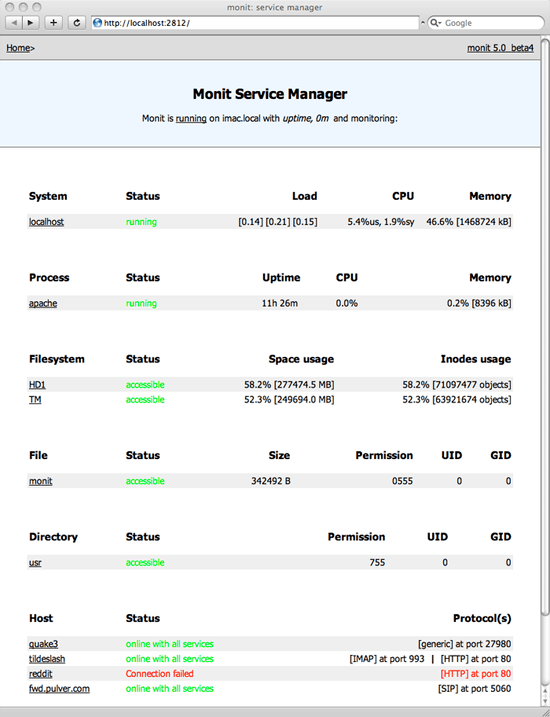
Monit not only monitors your server, but also attempts to remedy problems by taking predefined actions for certain situations. For example, if your database server crashes, Monit can automatically restart the service if this is the action that you want to take (hint: it usually is).
If you have more than one server that you need to monitor, then you can use M/Monit- an extended version of Monit that provides a simple way to monitor multiple machines.
There’s also an iPhone app available for M/Monit to help you conveniently check on your network without lugging around a laptop around.
2. Ganglia
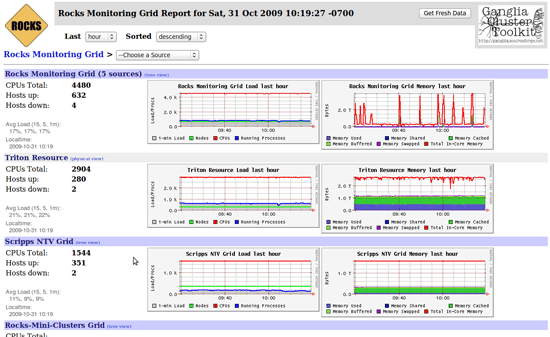
When you have a cluster of machines, it’s difficult to see how the whole cluster is doing all at once. Ganglia, instead, presents an overview of the whole cluster. This is a great tool to have set up when you’re working with a server cluster; with that said, it may be overkill for single-machine set-ups.
3. Munin
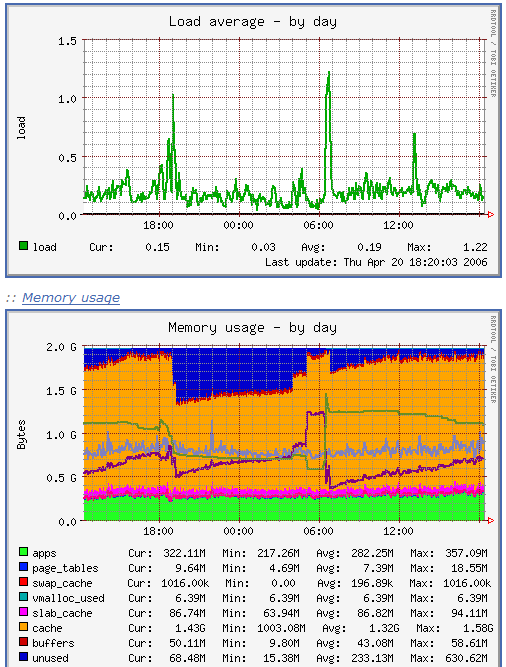
Munin monitors and graphs system performance metrics. It can automatically produce daily/weekly/monthly/yearly performance graphs and reports of many important metrics. It comes with the ability to monitor core system resources, such as memory, disk space, CPU usage, server applications such as MySQL, Apache, and Squid.
One of Munin’s greatest strengths is how simple it is to extend. With just a few lines of code, you can write a plugin to monitor almost anything. Being so easy to extend means that Munin is also a good choice for graphing things unrelated to server performance, such as the number of user signups or website popularity.
4. Cacti
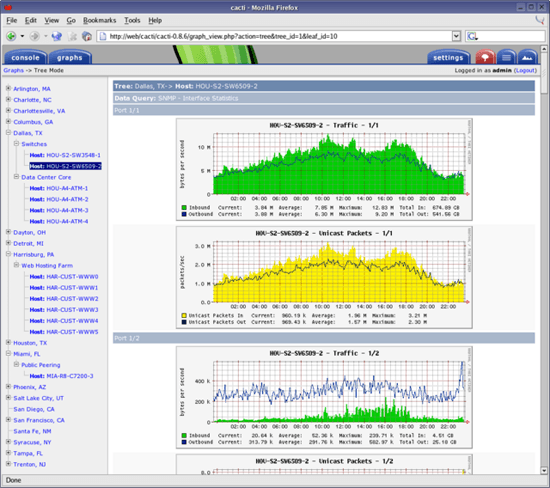
Cacti is similar to Munin in many ways. What is makes Cacti different though–and where it stands out in relation to Munin–is that it allows you to resize your graphs and view data for an arbitrary range. Whereas Munin has fixed daily, weekly, monthly and yearly graphs (unless you write a custom extension), Cacti lets you view your data however you want to: last 2 hours, last 4 days, last 6 months, out of the box. You can even visually select and zoom into regions on your graphs.
5. Nagios
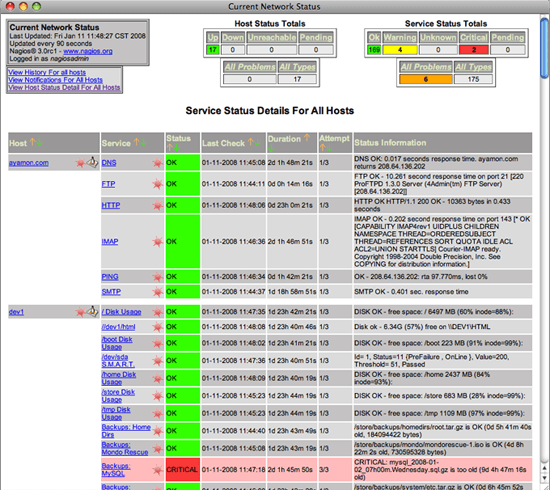
Nagios is "the industry standard in IT infrastructure monitoring,"–well, at least that’s what it says on their website. Nagios can be complicated to install and configure, but its wealth of features are unmatched by any tool out in the market and is geared for the experienced IT network administrator. Nagios supports monitoring of multiple hosts and can send out alerts via email, pager (if you still use this ancient technology) or SMS/text messaging. Like Monit, it can also be configured to automatically respond to problems.
6. Zabbix
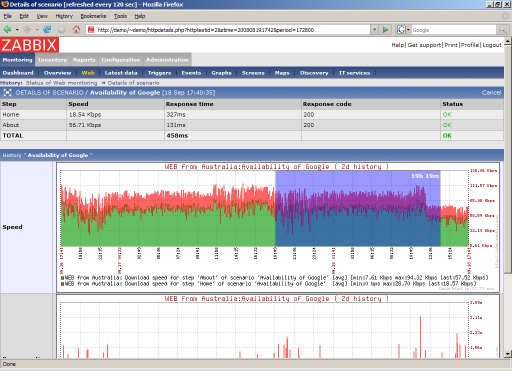
Zabbix is a feature-packed monitoring tool. It has great visualization support including user-defined views, zooming, and mapping. It can send out alerts via email, SMS or instant message. It also provides audible alerts, which can be useful when you’re physically near the monitoring machine.
7. Observium
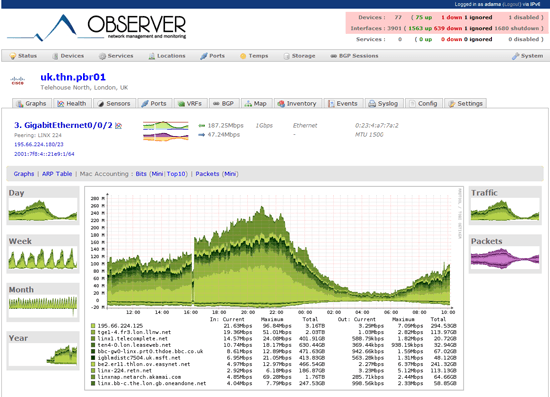
Observium is geared towards Linux, BSD and Cisco networks. It supports auto discovery of your network infrastructure, finding the networks that you’re likely interested in monitoring; this feature can be compared to how your Wi-Fi software automatically finds signals in range that you can jack into. Observium provides detailed graphs, and can be set up alongside Nagios to provide alerts. It also integrates well with Collectd (featured below) for a more robust interface.
8. Zenoss
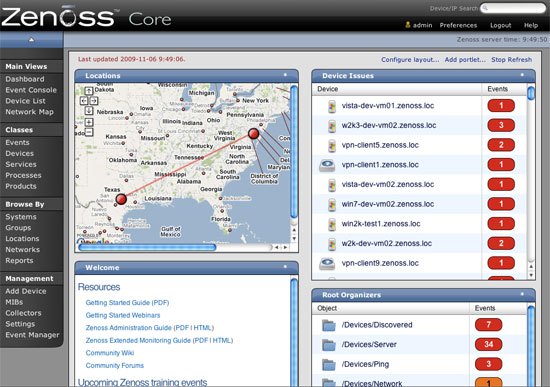
Zenoss is an open source version of the commercial server monitoring tool Zenoss Enterprise, written entirely in Python. It supports the Nagios plugin format, so many existing Nagios plugins can be used in Zenoss. One of the main highlights of Zenoss is its powerful yet simple to use user interface.
9. Collectd
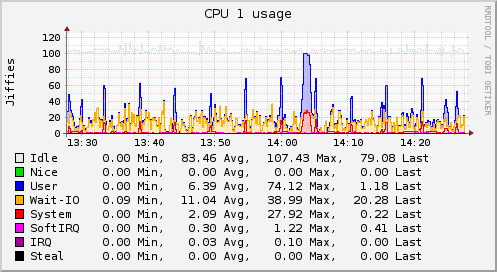
Collectd is similar to Munin and Cacti in that it focuses on graphing system metrics. Where it excels in is that it is designed specifically for performance and portability; this ultimately means it’s great on rugged systems, low-end systems, and embedded systems. Being designed for performance and low-system resource use means that Collectd can gather data every 10 seconds without interfering with your server processes, providing extremely high-resolution statistics. You can write extensions for it in C, Perl or Java.
10. Argus
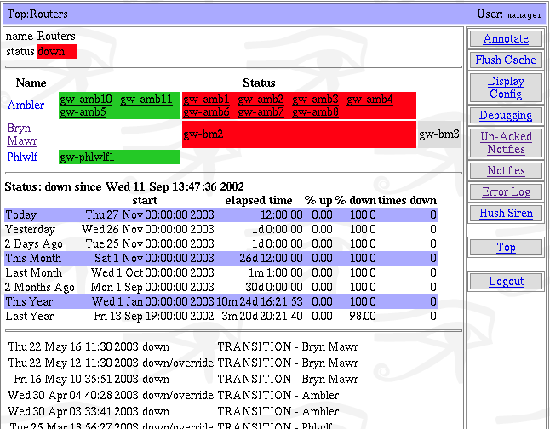
Argus focuses on the monitoring of network services, and supports IPv4 and IPv6. It has a nice alert escalation procedure: after sending out an alert and the problem still isn’t resolved within a fixed amount of time (because the systems admin is at home enjoying his sleep), another alert will be sent out to someone else.
What do you use?
Do you have experiences with any of the tools above? Do you use something else? Join our discussion in the comments.
Related Content
- Website Features That You Can Easily Offload
- 6 Tools to Help You Analyze a Web Host
- 7 Applications to Make Working with MySQL Databases Easier
- Related categories: Tools and Web Development


129 Comments
designfollow
November 4th, 2009
thanks for this great post
Roseli A. Bakar
November 5th, 2009
Thanks for the awesome list Ben.
Julian Flores
November 5th, 2009
Great Article Ben, Thank you!
Chime Host
November 5th, 2009
We currently utilize Cacti but I am really liking the auto restart feature in Monit.
Alberto
November 5th, 2009
Missed: OpenNMS ( opennms.org )
Kurt Kraut
November 5th, 2009
That’s a good list of monitoring software. I’d like to also present to you the Poor’s Man Monitor, a project I’ve started last week. Its on early stages of development but can already be used in production.
It’s meant to be a monitoring system to be used on desktop, not on a central server.
Further details on my project at http://code.google.com/p/pomamonitor/
Tyler
November 5th, 2009
Where’s OpenNMS?
Peter
November 5th, 2009
We use Nagios and Cacti on our servers, works like a charm!
:-D
simon
November 5th, 2009
Hobbit/xymon ?
the best open source network monitoring tool out there
Charly
November 5th, 2009
Great list Ben, and by the way, great Blog and articles on http://www.coderholic.com/ , I’ve been looking for one of those tools, I guess there’s none someone could install on a share server just to monitor one site or blog?
JeeSee
November 5th, 2009
After dubbing about open source network monitoring, I’ve tested several systems: Nagios, Zabbix, Hyperic and PandoraFMS. In combination with Microsoft clients my conclusion is that Zabbix and PandoraFMS were the best suitable in our network. In the end: PandoraFMS wins, because of the user-kindly webinterface and configuration of agents.
http://www.pandorafms.org
ruben
November 5th, 2009
Thanks you!
Michael
November 5th, 2009
Great post.
I’m a long-time user of Cacti (and MRTG before that, – it’s a great tool.
Some of the others a worth investigating. Thanks.
NOB
November 5th, 2009
We use ZABBIX. What is missing in your text is:
ZABBIX can fix problems in the same way like you mentioned for Monit and it has one of the best correlation engines
in the world ! That is not just my opinion, it seems.
See here: http://www.thecepblog.com/2009/03/23/a-review-of-zabbix-zabbix-rules-part-2/
mgpyone
November 5th, 2009
Very Nice one !!
Cheer Up :)
NOB
November 5th, 2009
Nice list of tools.
We thought about replacing our in-house developed solution
for capacity management by collectd.
After reading all the texts for all the tools:
Everything you mention as “special” features in your blog for Nagios, Zenoss, Argus, Munin, Ganglia and Monit is integrated in ZABBIX out-of-the-box or can easily be done with ZABBIX, too.
The exception is the iPhone App for Monit, but ZABBIX supports Jabber. So any Jabber-client should work that way.
No experience with that, though.
ZABBIX is simply a good solution, especially for distributed monitoring (DMZ, remote sites, etc.)
Mark
November 5th, 2009
Don’t forget about monitoring the config of your devices – http://www.open-audit.org
Free, open, PHP, MySQL, Bash, VBScript. Audits Linux and Windows machines.
Ian Purton
November 5th, 2009
Status2K (which I own) provides a server monitoring service with the ability to see live statistics. This is great for monitoring a server and seeing what is happening right now.
Also Status2K provides the ability to view the logs and see bandwidth usage over time.
However it’s not free like the above tools, but we do offer great support. http://status2k.com
PelFusion
November 5th, 2009
i was looking for such tools to monitor my server…thanks for the list
Ozzik
November 5th, 2009
I use Xymon (ex-Hobbit). Somehow not a lot of people know about it, but it’s a great monitoring tool.
Ingo Hoffmann
November 5th, 2009
You should add Opsera Opsview which is Nagios made right :)
slaFFik
November 5th, 2009
Really great list. Haven’t heard about most of them!
Thank you for collecting them all in one place.
Colum
November 5th, 2009
Great post. I was using munin but now I might look into some other programs.
Selvam
November 5th, 2009
nice collection…I came to know some new monitoring service…thanks
Thomas
November 5th, 2009
This its the Point that a Good Site need. Because with your Traffic you need it ones more. Thanks for this great inside infos.
Pascal
November 5th, 2009
Thanks for the great roundup. I’m not personally a developer, do all these require work on your site/server to start monitoring?
I met an interesting chap last week who recently launched a wonderfully simple monitoring service called Nimbu.net. Without any coding this service will keep checking your sites are available and if not will email and sms you. Currently in beta.
Cheers
Rob
November 5th, 2009
Currently using Nagios for monitoring our production environment; coupled with a few net plugins (such as the JBoss Nagios plugin: http://www.jboss.org/community/wiki/JBossNagiosPlugin to monitor heap sizes).
Probably looking to combine Munin and Nagios to provide some utilization graphs as well.
Good post; have to say Observer looks interesting as well, with its auto-discovery feature.
Geo
November 5th, 2009
Another one to add to the list is called, The Dude, it’s a network monitor that automatically scans all devices within specified subnets and can draw and layout a map of your networks, monitor services of your devices and alert you in case some service has problems.
http://www.mikrotik.com/thedude.php
Gopal Raju
November 5th, 2009
Useful stuff!
Rodrigo Freitas
November 5th, 2009
I use NINO, with good results. NINO is writen in PERL and has web access, graphics, notification and others. http://nino.sourceforge.net/
me
November 5th, 2009
Great article for linux and apache people! I have to monitor both types. Any suggestions for windows/asp.net crowds?
Daniel15
November 5th, 2009
Nice post, thanks. :D
David
November 5th, 2009
MRTG – for not only routers and switches, but it does servers and services, laod balancing, temperature monitoring and it is free.
A great comercial packaage that i use is Link Analyst from Network Instruments – inexpensive, but has alerts and analysis builtin….web interface, multiple clients with segregated access…
Excellent list BTW…!
Phil C
November 5th, 2009
Mikrotik Dude is free and does everything all of these tools in the article do and more! without the hassle of configuring PHP and Web services.
Memoryweaver
November 5th, 2009
Excellent summary — I hadn’t realised there were so many free products out there. Do you have a favourite?
Glenbot
November 5th, 2009
Fantastic post! It’s nice to see something other than online design tools or CSS tips.
David Mytton
November 5th, 2009
I’d like to include http://www.serverdensity.com – a hosted internal server monitoring service for Linux & OS X that my startup provides, which does include a free option.
The tools you mention in this post are all excellent open source tools but often require a lot of time and effort to set up. They’re certainly suited to larger companies with big requirements for flexibility. Not so useful for smaller companies.
Joachim
November 5th, 2009
Does anybody know about a monitoring system, which checks, if there are trojans or other malware on my server/website?
Matt
November 5th, 2009
We use Xymon (http://www.xymon.com) at work for ~400 servers. It works well for that size of an environment. I’ve implemented Munin before, and tried Nagios and Zenoss, both of which were ridiculously complex to setup rules and notifications for (overly so). That’s probably because I’m so used to Big Brother / Xymon, but oh well.
Anyone else care to comment on the other products in a large environment?
makini
November 5th, 2009
We use Zabbix. It’s better geared for large-scale enterprises, collocation or service provider sized networks and amount of hosts. It stands in comparison to Zenoss and Nagois by capabilities and features.
Cacti and Monit are more single-host monitoring oriented. Others I’m not too familiar with.
Ed
November 5th, 2009
Thank you for the information. More than once, I have found myself in a position where a free version of some of these services was a need, but I wasn’t sure which tool would actually do it.
Also, this article needs to be proofread again.
Andrew Rodgers
November 5th, 2009
Don’t forget the monitoring & reporting tools built into webmin, over the last few years webmin has become a powerful tool with releases for most distros. You can set up customized email alerts, as well as default actions for services.
(Disclaimer: I use webmin a lot but am no way affiliated, and have not contributed to the project in any way)
Andrew
Sek
November 5th, 2009
So, The topic is not “10 Free Server” and “10 Network Monitoring Tools”
It’s rather “10 Free Server Monitoring Tools” and “10 Network Monitoring Tools”
By the way, Thanks for good article. I would change from Cacti to Monit tomorrow.
Matt Ray
November 5th, 2009
Thanks for the mention of Zenoss, but that screenshot is from version 1.1 and looks nothing like the application anymore. We just released version 2.5 last week, so I encourage your readers to check it out.
http://tr.im/core2_5_0
Kimball
November 5th, 2009
Nice post. I just started to get nagios installed for our network. It does take some reading and learning to configure everything correctly, but I’ve got it monitoring linux, novell, windows, printers, out phone system, and cisco routers and switches. I kinda wish I saw this post 2 weeks ago when I started this project. oh well.
mattymattmatt
November 5th, 2009
Great post. We use Cacti for our University network reporting.
Justin Dorfman
November 5th, 2009
Great post Ben! Only program you forgot to include is Spiceworks…
gillibod
November 5th, 2009
You forgot Splunk at http://www.splunk.com
Bryden
November 5th, 2009
GroundWork Open Source is another great monitoring tool. Provides an interface for Nagios config changes rather than editing text files. You can download the community edition for free.
http://www.groundworkopensource.com/
Ben Pilkerton
November 5th, 2009
Sometimes a hosted solution is better/easier/more reliable. I’ve found both http://mon.itor.us/ and http://pingdom.com/ useful. RRDTool is a great tool if you want to roll your own.
NOC Guy
November 5th, 2009
We currently utilize Nagios and Cact. But we are looking for a program (or possible Cacti can be enhance) that will give customers realtime access without opening up our private network. Presently we have to forward customers utilization via report request.
Any suggestions?
Ben Dowling
November 5th, 2009
Thanks for the feedback and comments everyone, especially those listing monitoring tools that weren’t included on the list. There are lots out there!
Brian Nagy
November 5th, 2009
Little known but better than the few open source options I’ve tried (Big Brother, MRTG, Cacti)
is…. Traverse (http://www.zyrion.com/)
Bhavesh
November 5th, 2009
OpenNMS should be on this list… other than that, pretty good list.
Good
November 5th, 2009
hey, great list of apps for monitoring servers and services. as my net presence expands and i include more hosts, these apps will help me keep an eye on what’s going on so my mind can keep an eye on the prize.
Aitor
November 5th, 2009
A great list and a nice work, thanks!!
Here you cand find another one, in Spanish: Pandora FMS
http://pandoramon.sourceforge.net/es/
http://pandorafms.org/
Martin
November 5th, 2009
This is a good list, but xymon is better than all of these.
Stefano
November 5th, 2009
We are using the freeware version of PRTG Network Monitor from Paessler (I’d say that this is the best easy-to-use monitoring product for Windows)
http://www.paessler.com/prtg
dev_quest
November 5th, 2009
Nice list. I have been trying to setup some free monitoring for my blog. Been too lazy to do the research. Thanks for the list.
Steve Keller
November 5th, 2009
You should add “wrapper” products for Nagios that take away the difficult and time-consuming configuration files (AKA “Here be dragons”). Both Opsview (which we use) and Groundwork have community editions that are free.
Antti Kokkonen
November 6th, 2009
I’ve been using Cacti which has been great, but I gotta say Monit’s iPhone App makes it tempting :)
Simon Gattner
November 6th, 2009
For simple live-monitoring of small and medium Websites I also use ALiveLog.
RG SYSTEMES
November 6th, 2009
Nice job Ben but it should be nice to do the same job for the SaaS Monitoring systems. We finished to develop some months ago a SaaS Monitoring Tool called RG-Supervision.
SaaS tools allow a new offer to the small and medium sized companies who don’t want to invest money and time before testing the product, who wants to be free to change tool, change supplier and easily stop to use the product. With the open-sources products, you still have a start invest to set up such a tool into a company and you need to have some internal competences to manage this tool… With SaaS product, you can open account immediately, you can use the interface directly, you can stop the relation at any time etc… Flexibility required by the company now !
If you are interesting by this new kind of tools, you could take a look at RG-Supervision.
Best regards,
Grégory
Joachim
November 6th, 2009
check this one: http://www.reinvigorate.net
very nice graphics and free!
jlmarina
November 6th, 2009
Where is Osmius?
http://Osmius.net
NetDiva
November 6th, 2009
GroundWork Monitor 6.0 is a great tool. The community edition is free and the enterprise edition is only $49 for 100 devices or less.
* Easy to install wizard to help optimize the monitoring performance.
* Availability monitoring to alert if devices are up or not.
* Ability to monitor servers, devices and applications that gives you the flexibility to monitor all of the integral components within your network.
* Performance monitoring to give insight on latency before a server is offline
* Basic auto-discovery and configuration tools to help identify additional devices on the network which is a great time-saving function if your network is constantly changing.
* Built on the same open-architecture as Enterprise Edition, Community Edition is easy to integrate and customize.
http://gwos.com
Tyler
November 6th, 2009
spiceworks http://www.spiceworks.com
Design Informer
November 6th, 2009
I agree with Joachim. Reinvigorate is cool.
Tobbi
November 7th, 2009
Smokeping is also a great tool for network-monitoring.
http://oss.oetiker.ch/smokeping/
Japh
November 7th, 2009
I found a great tool for simple network monitoring today actually. It’s called MetaPing and it’s for “visual ping monitoring”. Really simple, but great for monitoring latency and stuff on your servers.
http://www.hammer-software.com/metaping.shtml
peter
November 8th, 2009
I’d also suggest to keep an eye on ScopePort. http://www.scopeport.org – Seems to be a good combination of great usability with decent functionality.
Salvador
November 8th, 2009
FAN is a “wrapped” solution for Nagios/Centreon, up&running in less than 20 minutes:
http://fannagioscd.sourceforge.net/drupal/
Includes CentOS,Nagios,Centreon,Nagvis & NaReTo.
Also, OpenNMS “sans effort” includes CentOS&OpenNMS in a ISO image easy to deploy:
http://opennmsse.free.fr/
Just try them!
NOB
November 9th, 2009
To “NOC Guy”
Why not use ZABBIX ?
It provides a good scheme for user access rights based
on host groups and the interface just needs a PHP-enabled Webserver and a Browser.
It gives you real time access to alarms and data.
HTH,
NOB.
Nacnude
November 9th, 2009
I have to cast my vote for Xymon (hobbit). We use it in a very large organization (all OS’s). It might be ugly but it’s quick and you see system graphs and statistics right away. Seems like with the others its either over-organized or slow to get system data quickly. Best troubleshooting and alerting tool I have used. Also, nice that the agent config (bbmon) updates with out restart it.
Ivan
November 10th, 2009
next, majapahit!
check this out: http://www.majapahit.codeplex.com
thanks.
Ryan Matte
November 10th, 2009
I’ve been using Zenoss for almost a year now. It is very powerful. There are some types of monitoring info which I have had to write custom scripts to gather, but I am always impressed with just how easy it is to integrate custom scripts with Zenoss. The UI is very nice and a huge time saver (it is also in the process of getting a major overhaul to look and function even better). I suggest that you come take a look at Zenoss the new Zenoss community site: http://community.zenoss.org. Or stop by the IRC channel: irc.freenode.net – #zenoss
Jason Dixon
November 11th, 2009
Hi Ben,
Interesting article. I find there are bits of each app that are useful, but overall they all suffer from the “built by techies for techies” stigma. Zenoss is probably the most user-friendly in this list, and I like some of the ideas that ObserverNMS has introduced. Unfortunately, they still suffer from some major usability issues (IMHO).
Not to sound like a marketing droid, but you might want to keep an eye on Circonus. Built by the same folks working on Reconnoiter, I think it’s going to shake up some of the ideas in the monitoring/trending/ECA arena. We’re accepting beta signups now, if you’d like to try it out when it goes private beta.
http://circonus.com/
Thanks,
Jason
Alex Peterson
November 11th, 2009
Great list. Definately will be using some of these.
Umar Draz
November 14th, 2009
Hi,
Nice article, for process management MONIT is great we can easily customized as per our requirements and the other end for graph management CACTI i think is better.
Thanks
Umar
akp982
November 16th, 2009
Thanks :-)
Really nice article with some great software im going to give a try.
Cheers for sharing
Rick
November 19th, 2009
Good stuff! Thanks for pointing out Monit. I like the simple layout.
Another hosted server/service monitoring solution to consider is Panopta. It’s not totally free, but it does kick ass. :)
Fred
January 2nd, 2010
Nice post, I always used zenoss but think that will give zebbix a try
Jaspal Singh
January 19th, 2010
Nice article with list of free server & networking tools.
Thanks for sharing.
alex web
January 28th, 2010
good choice to use zibbix no doubt i use it http://www.miempresaenlinea.com and its great performance
DavidV
February 9th, 2010
HI i apreciate all of your articles thanks…
Nikhil Kumar
March 23rd, 2010
May I know please how Sitescope is different from all others tool available in the industry.
Regards,
Nikhil
HM
April 21st, 2010
I use zenoss with my servers and works great.
vinay
April 26th, 2010
Nice article with list of free server & networking tools.
Thanks for sharing.
chetan
May 3rd, 2010
Zenoss, Zabbix, even Groundworks are good for “lab” setup, Real-world “monitoring” comes from Nagios. Earlier versions of Nagios were seemingly difficult to get started with. With 3.x getting Nagios up and running is breeze next part if adding devices, servers to monitoring system other systems Zenoss or Zabbix administration job turns into “data entry” (for hundreds of thousands or devices) job sure these tools provide you facility to “import” profiles from xml, spreadsheet etc … Bottom line is Linux is about files and console Try automating configuration for Zenoss, Zabbix! and real-world Linux/UNIX admin will narrate his experience.
BT
May 5th, 2010
I analyzed most of these for a new deployment we were doing at work. They all have great attributes, but many have their niche market – Ganglia, for instance is geared for clusters. Distributed monitoring (i.e. monitoring via proxy/node/slave at remote locations) was important for us and that narrowed the field. We needed a product that would scale to thousands of hosts and products from several different vendors. We also needed robust alerting, graphing and poll cycles.
We narrowed down to two: Zabbix and OpenNMS. And ended up going with Zabbix as it had distributed monitoring support very well out of the box. We’ve truthfully never had a monitoring situation come up that we couldn’t make Zabbix do what we wanted.
I used the NMS comparison matrix at wikipedia extensively to select software for testing and to weed out ones that lacked the features we needed. http://en.wikipedia.org/wiki/Comparison_of_network_monitoring_systems
Nagios was my top choice going into the process, however we were going to have multiple people (10+) making changes – adding hosts, updating triggers, adding new templates and the Nagios text-file configuration makes it easy to break something. (Although as one poster mentioned, this would definitely be a plus for someone looking to alter config files automatically.) There are some GUI configuration frontends out there, but they weren’t mature enough for us at the time. I also couldn’t justify picking software where getting usable graphs was via an add-on. Graphs are too important (for us anyway) to be relegated to a add-on/plugin.
Lastly, I really liked the look and feel of ObserverNMS, but just couldn’t make it work for us. I would highly recommend checking this out for monitoring devices/hosts from a single location.
Again, in the end, we chose Zabbix and haven’t looked back. We’re running 1.8.2, monitoring thousands of hosts and tens-of-thousands of items and it’s rock solid.
John
May 8th, 2010
Check also cloud-based service Monitis http://portal.monitis.com (and its free sister product http://mon.itor.us). It provides similar functionality as Nagios but as a SaaS solution and it is very scalable.
Gajula Vinod kumar
May 8th, 2010
Nagios is free as many as server and as many services (we can also add your custom made scripts to run) its a fantastic tool , we are using and ready to provide service
Sri
May 11th, 2010
I started using Zabbix 2 years before..its a great opensource monitoring tool. Moreover i started installing Mikoomi..check out http://www.mikoomi.com
Mikoomi has already released agents for DB2, WebSphere and Java JVM
Mikoomi – the leading open-source enterprise monitoring appliance company has released a monitoring plugin agent for IBM’s WebSphere Application Server (WAS). The solution consists of the Mikoomi virtual appliance and plugin agents for databases and application servers.
The WebSphere monitoring agent monitors over 25 key metrics covering attributes from the JVM, thread pools, JDBC connections and web requests providing useful insight into the health and capacity of applications running on WAS. Furthermore, when user-configurable thresholds are reached, the agent sends alerts to emails, pagers, cell phones and can be configured to integrate with enterprise Help Desk and Ticketing applications for automated workflow.
Performance, throughput and other metrics across WebSphere servers databases, and UNIX and Windows can be compared, graphed and analyzed to provide an end-to-end view of applications and IT systems.
kgr
June 1st, 2010
Very useful and helped me to round in on the monitoring tool that suits my needs.
Thanks a lot
aditya
August 9th, 2010
A pretty impressive list…I have another one that I use regularly for checking my website:
http://www.global-server-monitoring.com/nc/live_check.html
Daniel
September 16th, 2010
Does anyone knows a good open opensource tool for monitoring file servers? Ex: Reports about most un/used files, total sum filesize by extension file, total quota used by user, etc….
Daniel Cawrey
September 18th, 2010
I’m surprised there are no configuration management tools here. Lots of monitoring here, but when your configs are jacked, what will you do?
Maik
September 24th, 2010
Thanks for sharing this great collection :) *Thumbs up*
Soen
November 23rd, 2010
Hi Ben,
Thanks for sharing this info.
I don’t have any experience with any of these monitoring tools. I am network admin (new at the job) we have 4 servers (2 windows and 2 iSeries) and 25 workstations, PBX, Fortigate FW etc. What do you recommend? I like visual reports and information I can see (no codes and techinical info). Looking more for network load, server load (what is using what resources), server performance, intrusion etc..
Appreciate your advise on this.
Thanks!
Soen
Mark
November 27th, 2010
Great summary. Thanks for sharing.
2 Thumbs up for Zabbix.
Nebb
November 29th, 2010
Wow, nice collection! The comments alone could give you another months worth of work in regards to new(unmentioned) software to test.
Danny
December 3rd, 2010
Hey,
Thanks a lot :)
Danny
andrea
December 11th, 2010
Hello everybody.
my name is andrea.
I explain what my problem now, I need a monitoring service free (Linux or Windows), to monitor some hosts that are within the company I work for, I’m currently using Nagios, but I would need a server side, in addition to the control of Host, the control of the applications that are running.
I wanted to know if any of you could recommend one.
P.S: sorry for my speaking English
Thanks.
Andy
December 12th, 2010
Hello everyone.
I would need a monitoring service like nagios, but has also the ability to monitor the status of applications running in the host monitored by sarvizio.
Can you recommend one?
Thanks.
Ps. sorry for my speaking English.
Ali
January 18th, 2011
Also need to add Opsview to this category. wwww.opsview.com
Patrick
February 19th, 2011
Hi,
Nice post, did not know about some of these.
My company is currently using Zabbix to monitor different networks running real time applications where milliseconds almost matter.
Installation process can be improved but it remains approachable even at the early stages when discovering the tool.
Although after some months collecting a lot stats, the postgres DB backend is starting to stress CPU because of zabbix housekeeping…Anyone experienced similar situation with mysql (default), oracle or else?
Nagios was the first choice due to its reputation but customising it to your requirements becomes quickly a mission…Zabbix was easier to approach although it looked to good to be true but after months of challenging zabbix robustness, it seems on of the best small-large scale net monitoring tools. ^^
ayp1
February 23rd, 2011
I think Hyperic is probably the #1 in open source monitoring these days, being owned by Springsource (vmware) they have quite the backing, and with a completely open source “community” version, smaller companies can utilize the majority of hyperics features free of charge. Bar none, hyperic was the easiest to deploy and did the best job of auto discovering services on my equipment. I tested many systems before coming to this conclusion: Zabbix, Nagios, Zenoss, Spiceworks, HP Systems Insight Manager, OpsView, Triactive, and i’m probably forgetting one or 2…. point is, Hyperic beat them all hands down. It has all of the features you would expect from an enterprise grade monitoring solution, and it is offered for free…. for most users the community edition would be plenty sufficiant. We use the enterprise version at my office, however we are monitoring over 2000 systems (just counting servers)
Manoj
March 14th, 2011
Great work man!!!
Alex Lopex
April 29th, 2011
Congrats!!, BTW, recently RS got http://www.cloudkick.com.. free for small monitor.
IM like CHAT
April 30th, 2011
Hard and powerful network software, thanks! Here is another free LAN scanner which only shows NetBIOS names, MAC and IP addresses on a local network within a few seconds
http://www.bopup.com/products/scanner/
Arief
May 5th, 2011
Great articles.. really help me..
Thanks
Zeno Bresson
May 14th, 2011
Great list. That’s helps me to found the right solution.
Gedeon N
May 16th, 2011
this tools are very useful, thank a lot for share the info =D
Mike Lawson of trCreative
June 16th, 2011
Some good tools here, use a couple of them already, but some are new to me. Thanks!
Shiva
June 22nd, 2011
Hi,I have a couple of Windows 2k8 servers facing internet with Public ip ,can some one recomend any good open source momnitoring ,>>>
Walter Heck
June 24th, 2011
If you are looking for open source monitoring that is also software as a service, check out http://tribily.com. It’s based on zabbix without the need to run the server part of the monitoring setup. Nice and easy!
Disclaimer: I founded Tribily. Still think it is a very cool product though, and I love using it myself :)
Imraan
September 9th, 2011
Thank you for the wonderful post. Glad to know about the other monitoring tools also.
i have already used monit and munin. They are the best as per my requirements.
Dennison Uy
September 23rd, 2011
Somebody mentioned MRTG, which is another good tool. At work we use Hobbit, another free tool that works for both Windows and Linux.
Mohd Rashdan Jaffar
September 26th, 2011
Great info given. help me more on server & network monitoring at my office at this moment, really apeprciate.
Gaz
September 30th, 2011
Anything here for Infrastructure Engineers who use the MSFT stack, and arent linux geeks sitting in their underwear?
Moe
October 8th, 2011
+1 for xymon
It has everything you need, it’s easy to setup, and to scale to hundreds of servers.
Brian King
October 13th, 2011
Opsview’s my choice for open source monitoring: http://www.opsview.com
prateek
October 17th, 2011
hi BEN,
i describe you my prob.
i had a laptop,my personal
2 computers, one of them is server.
now what i wanr is i want tomonitor my server thru my lapy.
can i???????
waiting for ur reply
prateek
October 17th, 2011
i need details of keystrokes, screenshots, websites visisted
suggest a free software
Fred
October 24th, 2011
Thank you for this great list of monitoring packages.
I found 3 that I will test out.
Thanks again !
Kashyap
October 31st, 2011
Sri wrote: Mikoomi – the leading open-source enterprise monitoring appliance company has released a monitoring plugin agent for IBM’s WebSphere Application Server (WAS). The solution consists of the Mikoomi virtual appliance and plugin agents for databases and application servers.
Anyone knows where to find this plugin?
Stan
November 2nd, 2011
Thank you for this list; it’s very useful. I’ve tried Zenoss in the past. We’re looking at Netgrappler now, but I don’t believe that it is free. No pricing is listed on the Netgrappler site, and I don’t want to deal with salesperson calls from another network monitoring appliance company!
Niaz H
November 15th, 2011
Good article and list to begin with. The followup comments and observation is also a great resource to look into. I have been using Nagios for quite some time and also now looking into Ops View.
Gurwant
November 21st, 2011
Hello All, I am joining too late….really nice and helpful article from Ben and appreciate others effort as well. People have look on http://www.spiceworks.com/ this is also a very handy tool for network monitoring and Solarwinds too. Hope you like that.
Leave a Comment